

Quick Summary
The best flame retardant workwear for electricians is a complete layered outfit, with an arc-rated coverall as the outer layer and flame retardant base layers beneath. The garment's ATPV should meet or exceed the incident energy assessed for the task, and EN 61482-2 is the standard that matters most for arc protection.
- Check that the ATPV rating meets or exceeds the incident energy assessed for your task.
- Confirm the garment carries EN 61482-2, the arc protection standard for electrical work.
- Make sure every exposed layer is rated or non-melting, not just the outer coverall.
- Read the full EN ISO 11612 code string rather than assuming one letter covers all hazards.
- Retire any garment with visible damage, because its flame retardant rating no longer applies.
Table of Contents
- Why Electricians Need Flame Retardant Workwear
- How to Read EN ISO 11612 and EN 61482-2 Ratings
- Arc-Flash Clothing for Electricians: Matching Protection to Risk
- Ranked Comparison of Complete Outfits from EG Clothing
- Inherent vs Treated Flame Resistance: Why It Matters
- Building a Layered Outfit: Base Layers, Outerwear and Accessories
- Caring for and Replacing Flame Retardant Workwear
- Choosing Your Electrician Kit from EG Clothing
- Frequently Asked Questions
Why Electricians Need Flame Retardant Workwear
Electricians face arc flash and flash fire risks that ordinary workwear cannot withstand. A standard cotton boilersuit can ignite and continue burning on the body, turning a short electrical fault into a serious burn injury. Flame retardant workwear is designed to self-extinguish and limit heat transfer, which buys vital seconds to get clear of the hazard.
Choosing the right garment is not just about avoiding fire. It is also about meeting the standards that govern electrical work across the UK. EG Clothing offers flame retardant garments, from base layers through to arc-rated coveralls.
Watch out: a flame retardant garment is only protective when it is worn as a complete system, with every exposed layer rated, not just the outer coverall.
How to Read EN ISO 11612 and EN 61482-2 Ratings
Two standards do most of the work when you compare flame retardant clothing, but they answer different questions. Understanding what each one covers, and what it leaves out, is what stops you buying a garment that carries the wrong mark for your task.
EN ISO 11612: heat and flame protection for garments. This standard covers clothing designed to protect against heat and flame. It is marked with a set of codes, and each code tells you which hazard the garment has been tested against. The A codes relate to flame spread, with A1 and A2 indicating limited flame spread and surface flash resistance.
EN 61482-2: arc protection. This is the arc protection standard, and it is the one that matters most for electrical work. It reports an ATPV (Arc Thermal Performance Value) in cal/cm², which estimates the heat energy a fabric can block before a second-degree burn is likely. A higher ATPV means greater protection. Some garments also report an ELIM value, the energy level at which the fabric is expected to break open.
What neither standard covers. Neither EN ISO 11612 nor EN 61482-2 is an antistatic or electrostatic-discharge standard. If your work involves explosive atmospheres or sensitive electronics, you need to look for a separate antistatic rating, often shown as EN 1149. Nor do these standards cover high-visibility performance; that comes under EN ISO 20471. A garment can be arc-rated and flame retardant without being hi-vis, and a hi-vis garment can lack arc protection entirely.
| Standard | What it covers | What it does not cover |
|---|---|---|
| EN ISO 11612 | Heat and flame, with A, B, C and F codes for specific hazards | Arc flash, antistatic, high visibility |
| EN 61482-2 | Arc flash, reported as ATPV and sometimes ELIM | Heat and flame codes, antistatic, high visibility |
| EN 1149 | Antistatic and electrostatic-discharge properties | Flame, arc, high visibility |
| EN ISO 20471 | High-visibility performance | Flame, arc, antistatic |
Read the label, not the product name. For the full picture of safety clothing standards, see complete guide to high-visibility and safety clothing standards. Product names often include words like "arc" or "flame" without the garment carrying the corresponding certification. Check the markings on the garment label and the certificate that comes with it, and match the figures to your assessed risk.
Watch out: a garment described as flame retardant in the product title may carry only EN ISO 11612 and no arc rating at all, which makes it unsuitable for electrical work where arc exposure is possible.
Arc-Flash Clothing for Electricians: Matching Protection to Risk
Arc-flash clothing is not one-size-fits-all, and the single most useful thing an electrician can do is connect the workplace risk assessment to a specific garment rating. Most guidance stops at "wear arc-rated clothing"; the step-by-step method below is what turns a generic recommendation into a defensible PPE choice.
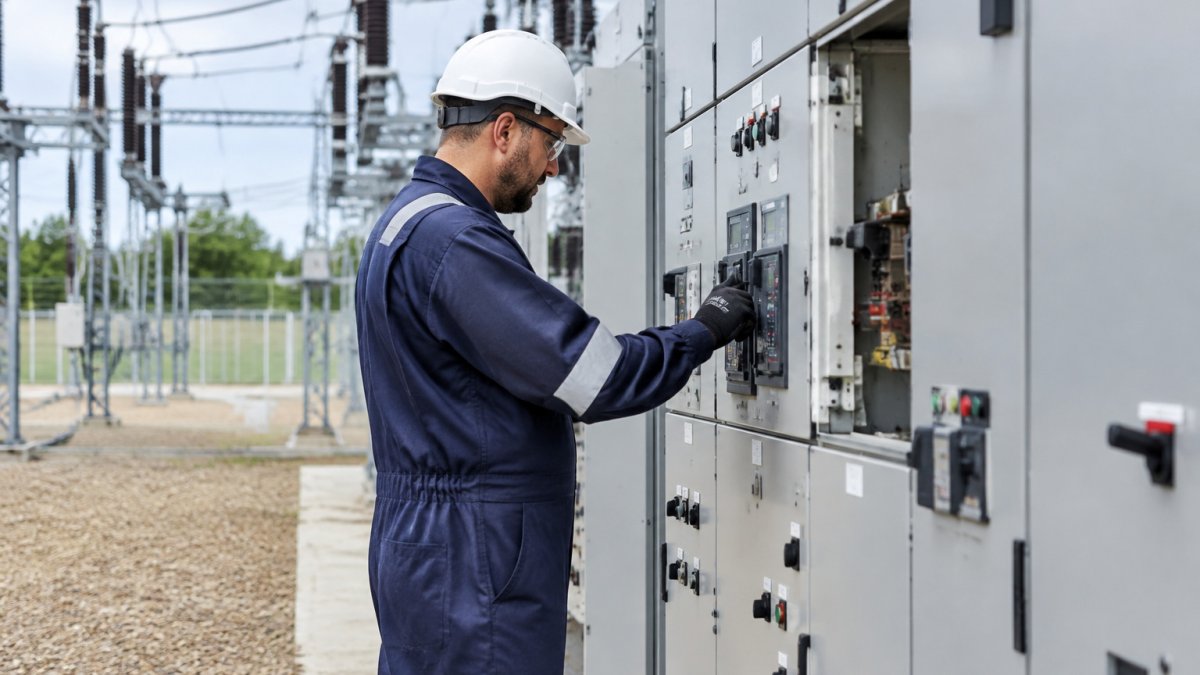
Step 1: Establish the incident energy at the task location. Your employer's risk assessment should identify the prospective incident energy for the work, usually expressed in cal/cm².
Step 2: Compare the incident energy to the garment's ATPV. The Arc Thermal Performance Value is the heat energy a fabric can block before a second-degree burn is likely. As a working rule, the garment's ATPV should meet or exceed the incident energy at the task location.
Step 3: Check the ELIM value where the fabric could break open. ELIM is the energy level at which the fabric is expected to break open. A garment can have a respectable ATPV but a lower ELIM, and the ELIM should also sit above the assessed incident energy for the task.
Step 4: Match the garment type to the task, not just the rating. Routine low-voltage maintenance may only need a flame-resistant base layer and polo. Distribution board work may call for an arc-rated coverall, and switchgear work may require a higher arc rating plus a rated base layer underneath.
| Work Type | Typical Need | Example Garment Feature |
|---|---|---|
| Routine low-voltage maintenance | Flame resistance, comfort | FR polo or base layer |
| Distribution board work | Arc rating and FR coverall | Coverall with ATPV rating |
| Switchgear and substations | Highest arc rating | Arc coverall with high ATPV |
| Outdoor or roadside work | Arc rating plus hi-vis | Hi-vis rated FR trousers |
Step 5: Confirm the complete system, not just the outer layer. An arc-rated coverall over a meltable synthetic base layer can still cause injury, because the base layer can melt against the skin under heat.
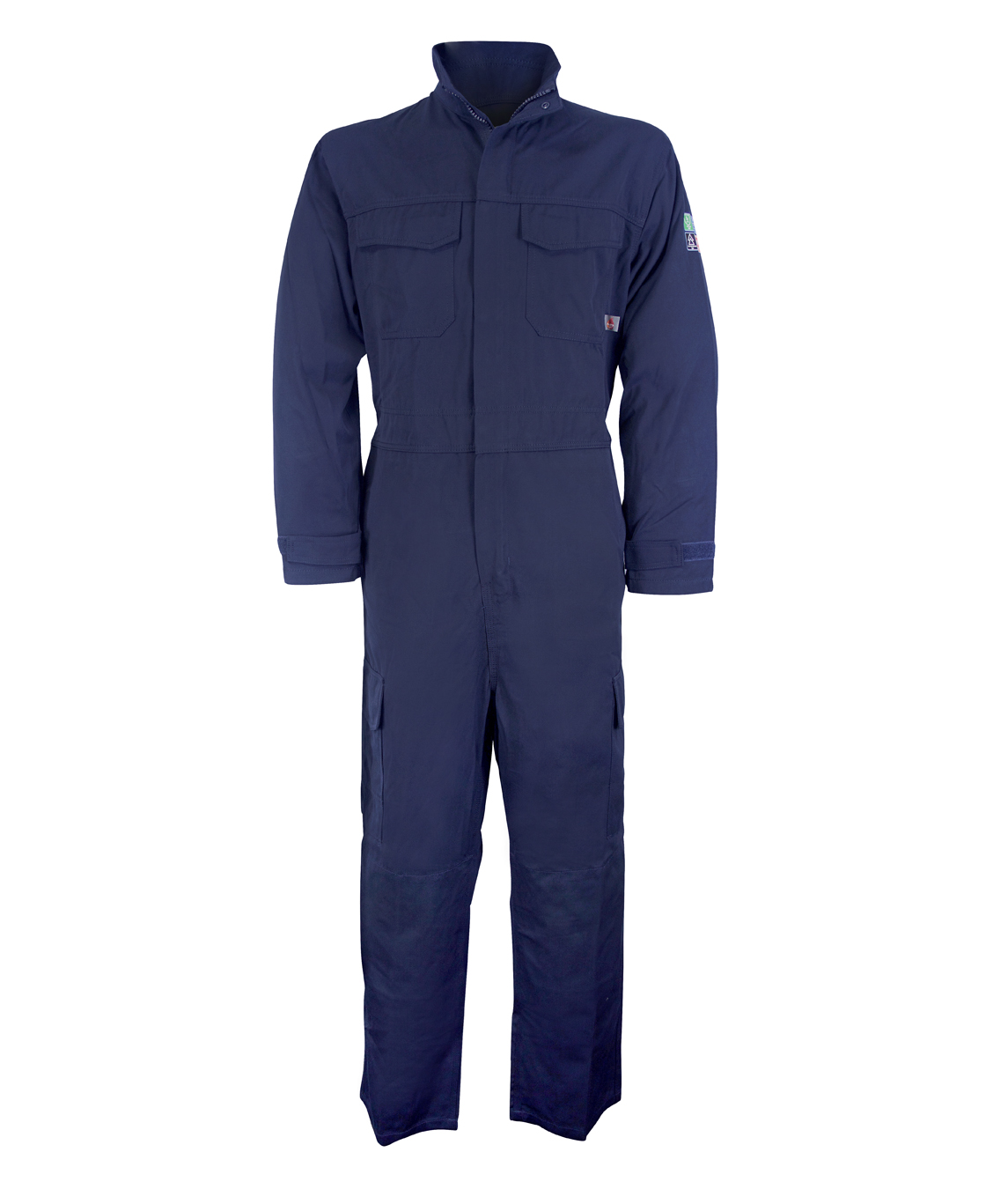
Our Oxygen Flame Arc Coverall 310GSM, priced at £114.79, carries an ATPV of 17 cal/cm² and is tested to EN 61482-2. It suits electrical maintenance and utilities work where arc exposure is a real possibility. For higher-energy switchgear tasks, check the ELIM as well as the ATPV before relying on any garment.
Watch out: a high ATPV on the label does not by itself make a garment suitable for every task; the assessed incident energy, the ELIM and the complete layered system all have to line up.
Ranked Comparison of Complete Outfits from EG Clothing
We rank these as complete outfits for electricians, because a single garment rarely covers every task. For demanding arc work, the Oxygen Flame Arc Coverall at £114.79 is one option, and the Copper FR Modacrylic Arc-Rated Coverall at £79.12 is a lower-cost arc option. You can browse the full range of flame retardant arc clothing in one place.
| Item | Price (GBP) | Key Rating | Best For |
|---|---|---|---|
| Oxygen Flame Arc Coverall 310GSM | £114.79 | ATPV 17 cal/cm² | Switchgear and utilities |
| Nimbus Flame Retardant Arc Coverall | £161.00 | ATPV 8.2 cal/cm² | Electrical maintenance and welding |
| Copper FR Modacrylic Arc-Rated Coverall | £79.12 | ATPV 17 cal/cm² | Budget-conscious arc work |
| Richter FR Hi-Vis Arc-Rated Fleece | £87.00 | ATPV 19 cal/cm² | Cold-weather outerwear |
| Surge FR Arc-Rated Hi-Vis Combat Trousers | £98.09 | ATPV 9.3 cal/cm² | Roadside and rail work |
Price (GBP)
Oxygen Flame Arc Coverall 310GSM (£114.79)
- Pros: Inherent FR fabric, ATPV 17 cal/cm², storm flap and knee pad pockets
- Best for: Electrical maintenance and utilities
- Skip if: your work is low risk and you only need a base layer
Copper FR Modacrylic Arc-Rated Coverall (£79.12)
- Pros: Arc rating ATPV 17 cal/cm², meets EN 61482-2
- Best for: Budget-conscious electricians needing full arc cover
- Skip if: you need hi-vis as a priority
Nimbus Flame Retardant Arc Coverall (£161.00)
- Pros: Lighter 250GSM blend, action back for movement, EN ISO 20471 Class 3 visibility
- Best for: Electricians who also weld and need flexibility
- Skip if: you need the highest arc rating available
Richter FR Hi-Vis Arc-Rated Fleece (£87.00)
- Pros: ATPV 19 cal/cm² and high visibility in one fleece
- Cons: It is an outer layer, so it must be worn over a rated base
- Best for: Outdoor electrical work in cold weather
- Skip if: you need a complete overall
Surge FR Arc-Rated Hi-Vis Combat Trousers (£98.09)
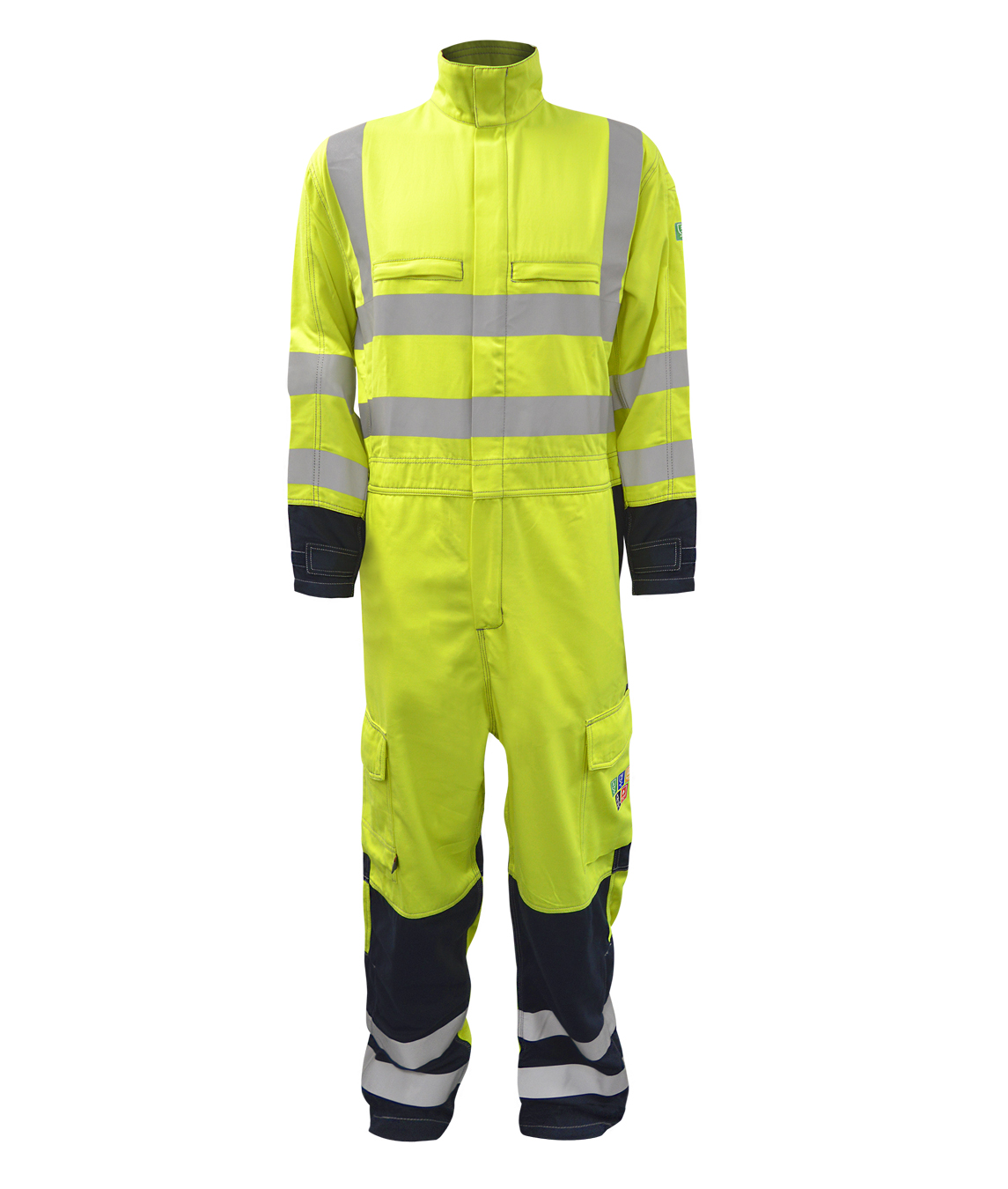
- Pros: Inherent FR, three reflective bands per leg, practical pockets
- Cons: Trousers only, so you still need matching tops
- Best for: Rail and roadside electrical work
- Skip if: you want a single-piece garment
Inherent vs Treated Flame Resistance: Why It Matters
Flame resistance comes in two forms. Inherent flame resistance is built into the fibre itself, so protection stays the same through repeated washing. Treated flame resistance is a chemical finish applied to the fabric, which can weaken with laundering and wear.
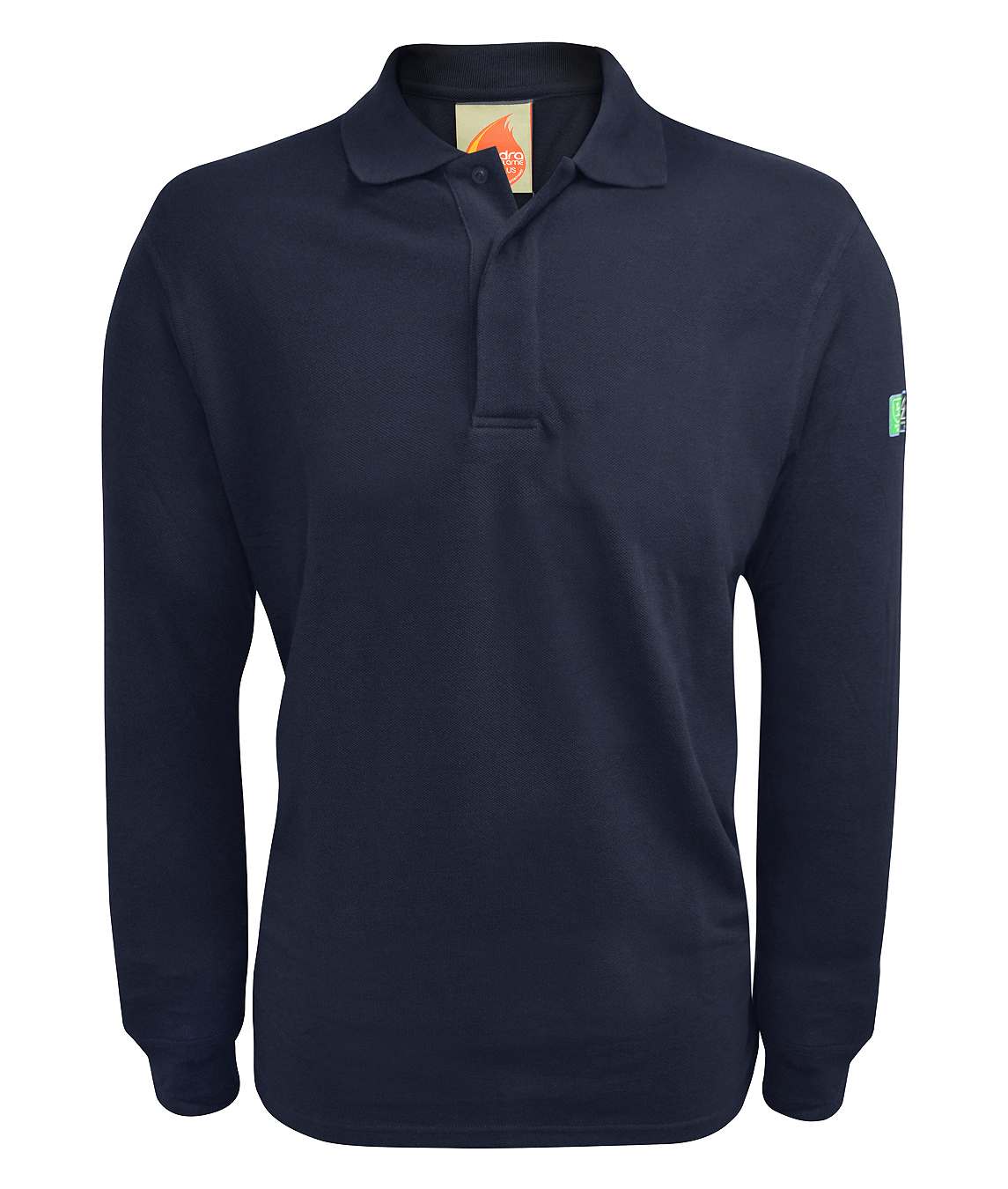
Several garments in this range use inherent blends of modacrylic and cotton. The Baird FR Arc-Rated Long Sleeve Polo Shirt at £30.36 uses inherent FR fibres. The Centaur Flame Retardant Cotton Jacket at £22.93 is an FR-treated cotton garment.
Building a Layered Outfit: Base Layers, Outerwear and Accessories
Protection works as a system. A base layer sits against the skin, the mid layer adds insulation, and the outer garment provides arc and visibility cover. Every layer that could be exposed should carry flame resistance, because a synthetic base layer that melts can cause injury even under a rated coverall.
A practical layered outfit might look like this: the KRYPTON FR Base Layer Navy T-Shirt at £28.05 as the base, the Richter Fleece at £87.00 for warmth, and the Oxygen Coverall at £114.79 as the outer arc layer. For a base layer option, you can buy an inherent flame retardant base layer balaclava.
Use the Centaur jacket at £22.93 where a lighter outer layer is enough, and the Artemis FR Cotton Trousers at £26.73 for lower-risk tasks alongside a jacket. You can also explore the flame retardant cotton jacket as a layer option.
Caring for and Replacing Flame Retardant Workwear
Follow the care label closely. Excess heat from tumble drying and harsh detergents can damage flame retardant performance, particularly on treated garments. Wash separately from non-FR clothing, and do not use fabric softener, which can coat fibres and reduce their protection.
Inspect garments before each shift. Look for holes, burn marks, broken zips, faded reflective tape and stretched seams. Any garment with visible damage to its FR fabric should be retired, because the rating no longer applies. Replace garments when they fail inspection rather than waiting until they wear out completely.
Keeping a simple log of when each garment was issued and washed can help show that your team's PPE is maintained.
Choosing Your Electrician Kit from EG Clothing
Start with your risk assessment, then build outward. For most electricians doing routine distribution work, a rated coverall plus an FR base layer covers the core need. To complete your outfit, you can browse the flame retardant jerkins category. Add hi-vis trousers or a fleece for outdoor and roadside tasks, and keep spare base layers on hand so you are never working in damaged kit.
Items in this range are priced from £22.93 to £161.00. Check sizing and certification details before you order.
Frequently Asked Questions
What is the best flame-retardant workwear for electricians?
The best option depends on the task. For arc-flash exposure, a coverall with an ATPV or EBT rating tested to EN 61482-2 gives the most measurable protection. EG Clothing's Copper and Oxygen coveralls both carry an ATPV of 17 cal/cm2 and meet EN ISO 11612 and EN ISO 11611, making them options for electrical maintenance. For lighter work, the Baird long sleeve polo or KRYPTON base layer provide inherent flame resistance under outerwear at a lower price.
What should electricians look for in flame-retardant clothing?
Look for inherent flame resistance rather than a chemical finish, since inherent fibres keep their protection through repeated washing. Check that the garment carries certification to EN ISO 11612 for heat and flame, and EN 61482-2 where arc exposure is possible. Confirm anti-static performance under EN 1149-5 if you handle sensitive equipment, and choose a fabric weight suited to your working conditions.
Is flame-retardant clothing the same as arc-rated clothing?
No. Flame-retardant clothing limits ignition and spread of flame, while arc-rated clothing is tested to withstand the heat energy of an electric arc, measured as ATPV or EBT in cal/cm2. Many electrician garments are both, but the two ratings test different hazards, so check each certification separately before relying on a garment for arc-flash work.
Do electricians need arc-flash protective clothing?
Where a risk assessment identifies arc-flash hazards, yes. Under UK law, employers are required to assess electrical risks and provide suitable protective equipment. Arc-rated garments are one part of that protection, alongside correct isolation procedures and other PPE.
