

Table of Contents
- Why Bulk Order Personalised Staff Apparel for Your Team
- Step 1: Determine Your Apparel Needs and Garment Types
- Step 2: Collect Staff Sizes and Plan Your Size Range
- Step 3: Choose Between Embroidered Workwear and Printed Workwear
- Step 4: Plan Logo Placement and Branding
- Step 5: Understand Bulk Pricing and Budget Your Order
- Step 6: Place Your Order and Manage Production
- Ensuring Quality and Consistency Across Orders
- Frequently Asked Questions
Last Updated: October 15, 2026
Why Bulk Order Personalised Staff Apparel for Your Team
Your team's appearance shapes how customers perceive your business. When staff wear consistent, branded apparel, they project professionalism and unity. A bulk order personalised staff apparel strategy does more than dress your workforce; it builds brand recognition, improves team cohesion, and creates a lasting impression on every customer interaction.
For construction crews, dental practices, hospitality venues, and retail operations, the right branded uniform transforms how teams present themselves. Yet, many businesses approach this haphazardly, ordering small batches from different suppliers and ending up with inconsistent colours, fits, and quality.
The smart approach is a structured bulk order. When you plan properly, you reduce cost per garment, ensure consistency across your entire workforce, and gain control over quality and branding.
Step 1: Determine Your Apparel Needs and Garment Types
Start by defining what your team actually needs to wear. This isn't about choosing randomly; it's about matching garment types to your industry, climate, and brand positioning.
Different roles demand different apparel. Customer-facing staff in hospitality benefit from smart polos or fitted shirts that communicate professionalism. Construction teams need durable workwear that withstands weather and physical labour. Healthcare staff require clean, easily laundered uniforms that meet hygiene standards. Retail environments may call for branded T-shirts paired with neutral trousers.
Consider your working environment. If your team spends time outdoors, hoodies and jackets provide practical layering. Indoor office or clinical settings suit lightweight polos and T-shirts. High-visibility work demands specialist workwear that meets safety compliance.
Choosing Between T-shirts, Polos, Shirts, Hoodies and Workwear
T-shirts offer versatility and cost-effectiveness. They work well for casual branding, creative industries, and teams that need frequent washing. The Pro RTX Pro T-Shirt at £5.53 per unit is a solid blank canvas for printing or embroidery, with a ribbed collar and side seams that maintain structure through repeated 60°C washes.

Polos project a more polished image than T-shirts. The Pro RTX Piqué Polo T-Shirt at £6.25 combines durability with smart styling. The piqué weave holds embroidery securely, and the taped neck reduces chafing during long shifts. For female staff, the Pro RTX Ladies Pro Piqué Polo at £6.58 offers a tailored fit with the same wash durability.


Hoodies and sweatshirts add warmth and casual branding. The Pro RTX Polycotton Sweatshirt at £9.82 features a brushed interior and ribbed cuffs, making it suitable for outdoor teams or layering in cooler months.
Workwear includes jackets, gilets, and specialist gear designed for demanding environments. These carry premium pricing but deliver durability and safety compliance that standard apparel cannot match.
Assessing Durability and Fabric Requirements
Fabric choice determines how long your branded apparel lasts. Cotton blends offer breathability and comfort but require careful washing. Poly-cotton mixes (like those in EG Clothing's range) balance softness with durability, resisting shrinkage and maintaining shape through industrial laundering.
Check washing requirements. Many branded uniforms need 60°C machine washing to remove stains and maintain hygiene standards. Fabrics that survive repeated hot washes without fading or losing embroidery definition are essential for healthcare, hospitality, and food service.
For construction and outdoor work, consider water resistance and fabric weight. Heavier fabrics withstand abrasion better. Specialist finishes (water-repellent treatments, high-visibility coatings) add cost but extend garment life in harsh conditions.
Step 2: Collect Staff Sizes and Plan Your Size Range
This step separates professional bulk orders from chaotic ones. Many businesses underestimate size diversity, ordering mostly medium and large, then discovering half their team has nothing that fits.
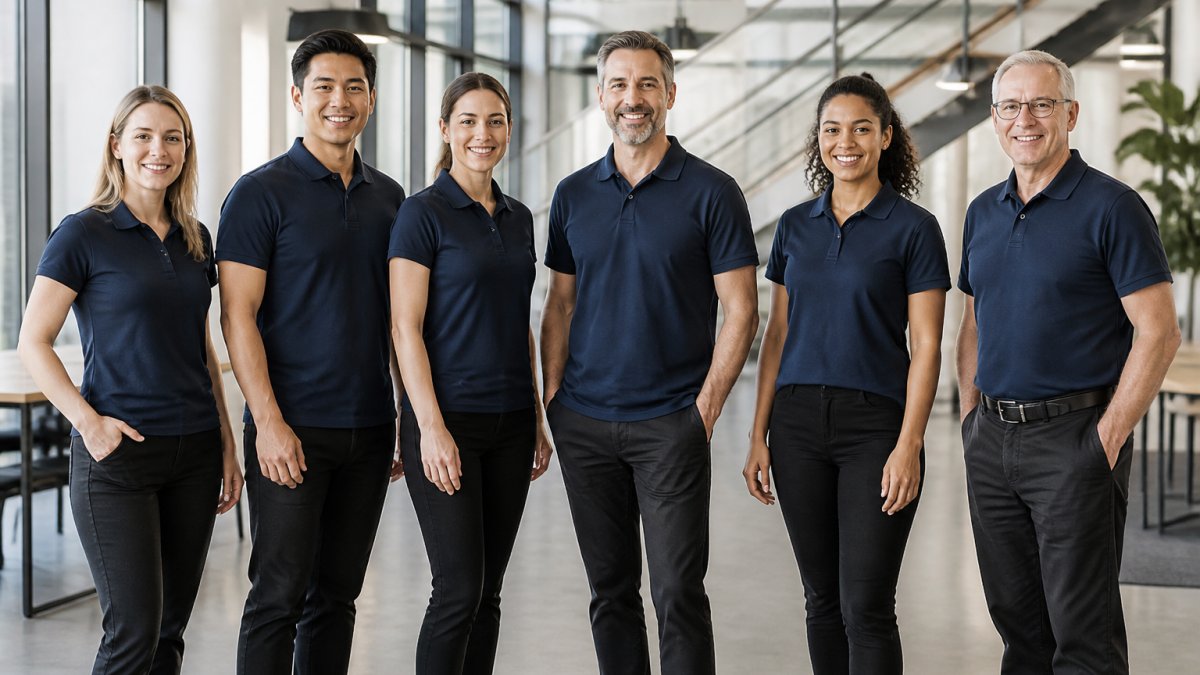
Request exact sizes from every team member. Use a simple spreadsheet: name, role, preferred size, fit preference (regular, slim, plus). Don't assume. A person who wears size 16 in one brand may wear size 18 in another. Fit preferences matter; some staff prefer relaxed cuts, others want fitted silhouettes.
Building an Inclusive Size Collection
Modern bulk orders must accommodate diverse body types. Ordering only XS to XL excludes staff and damages morale. Plan for a full size range from XS to 4XL or 5XL, depending on your workforce.
Many suppliers, including EG Clothing, offer both standard and ladies' fits. The Pro RTX Ladies Pro Piqué Polo uses tailored shaping that standard unisex polos cannot provide. This small detail improves fit and comfort for female staff, making them more likely to wear the uniform with pride.
Build a size matrix showing how many staff fall into each size bracket. This prevents over-ordering large sizes and under-ordering smaller ones. If your team skews toward larger sizes, adjust your order quantities accordingly.
Step 3: Choose Between Embroidered Workwear and Printed Workwear
This decision affects durability, cost, and visual impact. Both embroidery and printing can display your logo and branding, but they behave differently under wear and washing.
When to Choose Embroidery for Durability
Embroidery uses thread stitched directly into fabric. It withstands repeated washing, high-temperature laundering, and physical wear better than printing. Logos remain crisp and defined after 50+ washes. For healthcare uniforms, hospitality staff apparel, and any role requiring frequent industrial washing, embroidery is the superior choice.
Embroidery works best on sturdy fabrics like piqué cotton-poly blends. The thread anchors into the weave, creating a permanent bond. Logos appear slightly raised and textured, adding tactile quality and visual depth. Embroidered garments feel more premium and professional.
The trade-off is cost. Embroidery requires specialist equipment and skilled labour. Setup fees apply, and per-unit costs run higher than printing. For bulk orders of 50+ units, the per-item premium shrinks, making embroidery economical.
When to Choose Printing for Cost and Detail
Screen printing transfers ink directly onto the fabric surface. It's faster and cheaper than embroidery, especially for simple designs or small orders. Printing handles photographic detail, gradients, and complex artwork better than embroidery can achieve.
Printed logos fade gradually with washing and sunlight. After 20-30 washes, colours dull noticeably. For apparel with shorter expected lifespans (seasonal uniforms, promotional gear, casual team wear), printing suffices.
Printing works on any fabric, from lightweight cotton to heavy workwear. Setup costs are lower, and turnaround is faster. For orders needing quick delivery or budget-conscious operations, printing offers practical advantages.
Many bulk orders use both: embroidery for permanent branding (company name, logo) and printing for secondary details (role, location, seasonal messaging). This hybrid approach balances cost and durability.
Step 4: Plan Logo Placement and Branding
Where your logo sits on the garment affects visual impact and production complexity.
Chest placement is standard for polos and T-shirts. A small logo on the left chest mimics professional uniform conventions.
Back placement works for team-building events, sports teams, or when front space is limited. A larger logo on the back creates strong visual impact from behind.
Pro RTX Piqué Polo T-Shirt, 60°C Wash →
Sleeve embroidery adds subtle branding without dominating the garment. Logos on sleeves work well alongside chest placement for layered branding.
Full-front graphics suit T-shirts and casual wear but can overwhelm formal uniforms. Reserve this for promotional or event-specific apparel.
Consistency matters enormously. Specify exact placement measurements (e.g., "2 inches from left shoulder seam, centred vertically"). Provide artwork in high resolution.
Step 5: Understand Bulk Pricing and Budget Your Order
Bulk pricing is where your savings accumulate. Ordering 100 units costs significantly less per garment than ordering 10. Understanding the pricing structure prevents budget surprises.
Most suppliers offer tiered pricing: lower per-unit costs at higher order quantities. A basic T-shirt might cost £5.53 at 50 units. Polos and sweatshirts follow similar patterns. Calculate your total spend across all garment types and quantities before committing.
Bulk Order Discounts and Wholesale Pricing
Bulk discounts typically kick in at 50 units. Orders of 100-200 units attract steeper discounts. Orders exceeding 500 units may qualify for custom wholesale pricing negotiated directly with your supplier.
EG Clothing offers trade pricing for bulk orders, recognising that construction firms, hospitality groups, and healthcare providers need volume discounts. Request a formal quote specifying quantities, garment types, sizes, decoration method, and delivery timeline. A detailed quote prevents misunderstandings and hidden costs.
Factor in decoration costs separately. Embroidery setup fees apply once, regardless of order size. Per-unit embroidery costs depend on design complexity and stitch count. Printing setup fees are lower but per-unit costs may be higher for small orders.
Hidden Costs to Watch For
Shipping costs escalate with bulk orders. A 200-unit order weighs significantly more than 20 units. Request shipping quotes upfront. Some suppliers include delivery in bulk pricing; others charge separately. Confirm whether pricing is delivered to your location or collected from their warehouse.
Artwork approval fees sometimes apply if you require design work or logo adjustments. Confirm this isn't charged separately. Rush delivery or express production incurs premiums, typically 20-40% above standard rates.
Size distribution affects total cost. If you order heavily from one size, you may hit minimum order quantities for other sizes, driving up total spend. A balanced size range optimises cost efficiency.
Step 6: Place Your Order and Manage Production
Once you've finalised specifications, the ordering process begins.
Requesting a Quote and Artwork Approval
Provide your supplier with a detailed brief: garment types, quantities per size, colour preferences, decoration method, logo artwork, placement specifications, and required delivery date. Request an itemised quote breaking down garment costs, decoration costs, and delivery.
Artwork approval is critical. Submit your logo in high resolution (minimum 300 DPI). Specify exact colours using Pantone references for embroidery or CMYK for printing. Request a digital proof showing logo placement and size on your chosen garment. Review this carefully; small adjustments now prevent costly reprints later.
Once you approve artwork, production can begin. Confirm the production timeline and expected delivery date in writing.
Production Time and Delivery Expectations
Standard production takes time, and rush production costs more but suits urgent timelines. Delivery adds working days depending on your location.
EG Clothing's in-house embroidery and printing capabilities mean faster turnarounds than suppliers outsourcing decoration work. Fast turnaround reduces the time between ordering and equipping your team, allowing quicker brand rollout.
Track your order status. Inspect the first sample closely, check colour accuracy, logo placement, stitch quality, and seam integrity before approving full shipment.
Ensuring Quality and Consistency Across Orders
Quality control protects your investment and brand reputation. Poorly made uniforms damage team morale and customer perception.
When your bulk order arrives, inspect a representative sample from each size and colour. Check seams for loose threads or skipped stitches.
Document any defects with photographs. Contact your supplier immediately if quality falls short. Reputable suppliers replace defective units at no charge.
For future orders, maintain consistency by keeping detailed records: approved artwork files, colour specifications, size charts, and production photos from successful orders.
Reordering becomes easier when you've established a relationship with your supplier.
Bulk ordering personalised staff apparel transforms how your team presents itself to customers and colleagues.
Frequently Asked Questions
How do I choose between embroidery and printing for staff clothing?
Embroidery offers superior durability for high-wash environments like healthcare and hospitality, as stitching withstands repeated 60°C machine washing without fading or cracking. Printed workwear works well for detailed logos, photographic designs, or smaller orders where cost matters most. Consider your industry: construction and medical teams typically benefit from embroidery's longevity, while retail or office settings may prefer printing's flexibility and lower per-unit cost on smaller bulk orders.
What is the minimum order for personalised staff uniforms?
Minimum order quantities vary by garment type and customisation method. Contact your provider for exact minimums, as bulk order discounts typically apply at higher unit quantities. Smaller businesses can still access wholesale pricing; the key is confirming thresholds before requesting your quote to avoid unexpected costs.
How can I keep branded staff clothing consistent when reordering?
Request that your supplier retain your artwork file, approved logo placement specifications, and colour codes on file. When reordering, reference your original order number and request a visual proof before production begins. For multi-site rollouts, order all batches together if possible, or schedule staggered orders with documented specifications to maintain consistency across teams.
How long does a bulk order of personalised workwear take?
Standard production takes time after artwork approval, with delivery adding working days depending on location. Express services may reduce turnaround at a premium cost. Always confirm production and delivery timescales before placing your order, especially if you need apparel for a specific event, seasonal rollout, or staff onboarding deadline.