

Table of Contents
- What to Look for in Bulk Workwear Suppliers UK
- Price Comparison: What Bulk Orders Actually Cost
- Custom Workwear Embroidery Services: What Separates Good from Bad
- Turnaround Time for Custom Uniforms: Lead Times and Reliability
- Safety Standards and PPE Compliance for Bulk Orders
- Procurement Integration and Account Management
- Which Bulk Workwear Provider Fits Your Business?
- Frequently Asked Questions
Last Updated: September 23, 2026
What to Look for in Bulk Workwear Suppliers UK
Choosing bulk workwear suppliers UK businesses can rely on comes down to five things: sample testing, transparent unit pricing, embroidery quality, realistic lead times, and documented PPE compliance. Get any one of these wrong and you will pay for it across every reorder. This guide from EG Clothing compares what actually matters when you are buying branded uniforms at volume, and where cheap headline prices hide their real cost.
Most buying decisions start with a price per garment. That is the wrong place to start. A polo that costs less but fades after twenty washes, or a logo that cracks after three months, costs more in replacements and re-embroidering than the original saving. According to HSE guidance on PPE at work, employers must ensure protective equipment remains effective for as long as it is needed, which makes durability a compliance issue, not just a budget one.
Sample Testing Protocols Before You Commit
Never place a bulk order without physically testing a sample first. A common mistake is approving artwork on screen and ordering 200 units sight unseen.
Run this protocol before committing:
- Order one sample garment in each size bracket you need
- Wash it at the temperature your laundry contract uses, not the label minimum
- Check embroidery stitch density and edge definition after washing
- Confirm colour fastness against your brand's Pantone reference
- Test fit across the smallest and largest wearers on the team
- Time how long the sample took to arrive, as a lead-time benchmark
What most guides miss is that a sample tells you about more than the garment. It tells you whether the supplier's artwork team reads a brief properly. If the logo comes back the wrong size on a single sample, it will come back wrong on the full run.
Price Comparison: What Bulk Orders Actually Cost
Bulk workwear pricing is driven by garment cost, decoration method, and order volume. The unit price falls as volume rises, but decoration cost per item falls more slowly because each garment is still handled individually. That asymmetry is where most quotes become incomparable.
| Cost Element | What Drives It | Where Savings Hide |
|---|---|---|
| Garment unit cost | Fabric weight, brand, order volume | Higher volumes, simpler styles |
| Embroidery setup | Digitising the logo once | Reusing the same digitised file |
| Decoration per unit | Stitch count, number of positions | Fewer logo positions per garment |
| Delivery | Order size and frequency | Consolidated scheduled drops |
| Replacements | Fabric durability, wash care | Better base garments, correct laundering |
A realistic approach is to treat the garment price as roughly half the total.
Total Cost of Ownership Beyond the Unit Price
Work it out like this:
TCO = (unit price + decoration per unit) × quantity + replacement cycles + admin time
| Line | Cheaper polo | Durable polo |
|---|---|---|
| Unit price | £4.80 | £6.25 |
| Decoration per unit | £2.10 | £2.10 |
| Cost per garment | £6.90 | £8.35 |
| Order cost (250 units) | £1,725 | £2,088 |
| Expected replacement cycles over 2 years | 3 | 1.5 |
| Garments needed over 2 years | 750 | 375 |
| 2-year garment + decoration spend | £5,175 | £3,131 |
- Wash durability. A polo built to hold its shape and embroidery through repeated 60°C industrial washes, such as the Pro RTX Piqué Polo T-Shirt at £6.25, is a different proposition from a lightweight single-knit cotton polo that loses definition after a handful of cycles. Ask for the wash performance of the base garment before you compare prices.
- Decoration survival. Embroidery that cracks or puckers forces re-embroidery, which means re-handling a garment you have already paid for. Stitch density and backing quality determine whether that happens.
- Admin load. Every replacement order carries a purchase order, a delivery booking, and someone's time. Fewer replacement cycles means fewer of all three.
Bulk Shipping and Consolidation Costs
Delivery is the line most often left off a comparison, and it is the one that scales worst. Carriage is usually charged per consignment, not per garment, so splitting a 500-unit order across five sites can multiply the delivery line by five while the unit price stays the same.

Custom Workwear Embroidery Services: What Separates Good from Bad
Good custom workwear embroidery services hold their definition after repeated washing, keep logo placement consistent across batches, and use a digitised file that is reused rather than redrawn. Bad ones crack, pucker, or drift a few millimetres off-centre between orders.
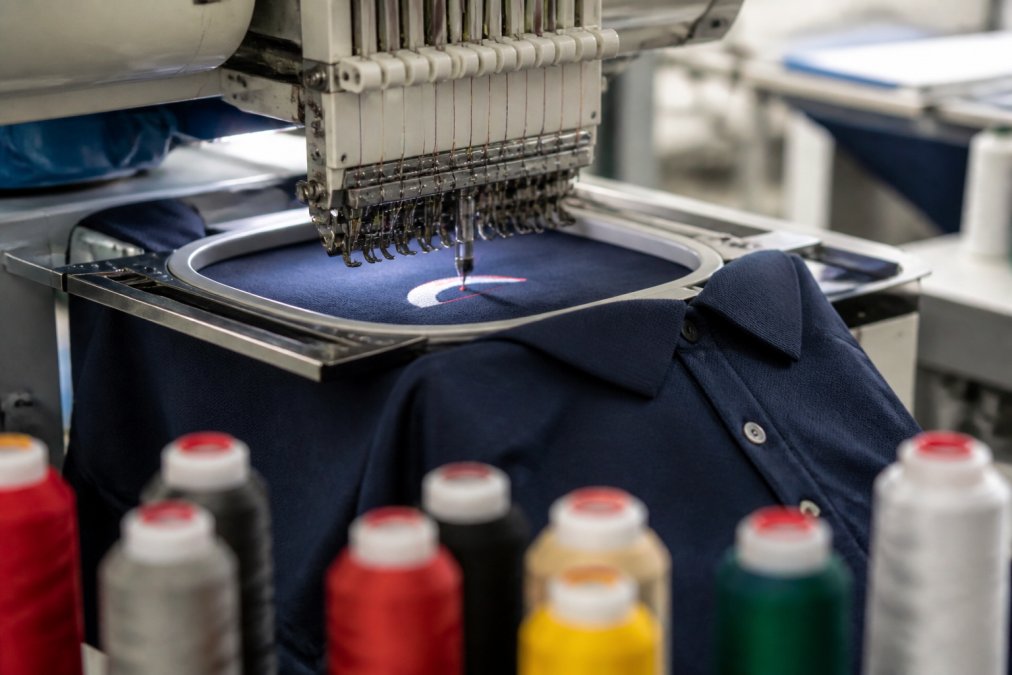
Three things separate the two:
Pro RTX Piqué Polo T-Shirt, 60°C Wash →
- Digitising quality. A properly digitised logo controls stitch direction and density. A poorly digitised one pulls the fabric and cracks at the edges.
- Placement consistency. Good suppliers lock the logo position into a template so batch two matches batch one.
- Fabric suitability. Embroidery needs a stable base. Structured piqué and poly-cotton blends hold stitches far better than thin single-knit cotton.
Turnaround Time for Custom Uniforms: Lead Times and Reliability
Turnaround time for custom uniforms typically runs from a few working days for plain stock to two to three weeks once digitising, decoration, and delivery are included. The variable is rarely the garment. It is the artwork approval and the decoration queue.
Ask any supplier three questions before ordering:
- What is the lead time from artwork approval, not from order date?
- What happens if a size is out of stock mid-run?
- Can you split delivery across sites without resetting the clock?
Scalability for Multi-Site Businesses
Multi-site orders fail when each site orders separately. You lose volume pricing, decoration consistency drifts, and nobody can tell you what was bought where.
Safety Standards and PPE Compliance for Bulk Orders
Ask for the certification documentation before you order, and confirm it applies to the exact style and colour you are buying. For construction and logistics teams, high-visibility clothing sits alongside other protective gear, and the standard that applies depends on the hazard and the environment. Check the current requirements with the HSE PPE regulations guidance rather than relying on a supplier's summary.
Procurement Integration and Account Management
Procurement integration is the difference between a supplier you tolerate and one that saves your team hours. At minimum, you want a named account manager, agreed service levels, and a reordering process that does not start from scratch every time.
Look for:
- A single account contact who knows your logo, sizes, and site list
- Agreed service level agreements covering lead times and defect resolution
- Reorder capability that reuses your existing artwork and templates
- Consolidated invoicing across sites and departments
- Stock-holding arrangements for your core lines so repeat orders ship faster
Which Bulk Workwear Provider Fits Your Business?
The right provider is the one that matches your order profile, not the one with the lowest headline price. Here is how to decide:
| Your Priority | What to Look For | Best Fit |
|---|---|---|
| Small team, first order | Low minimums, sample service, clear pricing | A supplier with published per-item pricing and small-run capability |
| Multi-site rollout | Consolidated ordering, split delivery, template control | A supplier with account management and stock-holding |
| High-visibility and PPE | Certification documentation, durable base garments | A supplier that provides compliance evidence per style |
| Budget-constrained | Transparent total cost, durable garments that last | A supplier with quality base garments at trade pricing |
Frequently Asked Questions
What should I look for when choosing a bulk workwear supplier?
Focus on four things: fabric durability (60°C wash tolerance matters for industrial laundering), embroidery quality that survives repeated washes, realistic turnaround times, and transparent pricing. Check whether they hold UK stock, offer sample garments before you commit, and provide dedicated account management. A supplier that can show you a sample polo with your logo after five washes will tell you more than any brochure.
Is it cheaper to order workwear in bulk from specialist providers?
Specialist bulk workwear suppliers typically offer volume discounts that general retailers cannot match. For example, a Pro RTX Pro T-Shirt starts at £5.53 per unit, and that price drops further at scale. The real saving comes from durability: garments tested to withstand 60°C washes last longer, so your cost per wear falls. Factor in embroidery quality too. Logos that crack after ten washes mean reordering sooner.
How do turnaround times compare between major UK workwear suppliers?
Turnaround time for custom uniforms varies widely. Some suppliers quote 10-15 working days but deliver in five weeks. Others hold UK stock and embroider in-house, which cuts lead times significantly. Ask specifically: is embroidery done on-site or outsourced? In-house production means faster turnaround and better quality control. Always get a written lead time and a contingency plan for peak periods like summer.
Are there UK-based alternatives to Workwear Express for small businesses?
Yes. Several UK bulk workwear suppliers cater specifically to smaller operations. EG Clothing, for instance, works with practices of eight staff as readily as larger construction crews. Key features to look for: no minimum order that excludes you, trade pricing that scales, and in-house embroidery so you are not paying a middleman. Small businesses often get better service from specialists than from high-volume generalists.
What are the benefits of using a specialist provider like EG Clothing for bulk orders?
Specialist bulk workwear providers offer in-house embroidery and print, which means faster turnaround time for custom uniforms and consistent logo placement across batches. EG Clothing stocks UK inventory, provides trade pricing, and assigns account management so you deal with one person. With 3,915 customers and a 4.8/5 rating, the focus stays on quality and durability rather than just shifting units.