

Table of Contents
- Why Branded Uniforms Matter for Retail Staff
- Retail Staff Uniforms: Choosing Durable Fabrics That Last
- Branded Polo Shirts for Retail Staff: Professional and Practical
- Bulk Workwear Pricing: Maximising Your Procurement Budget
- Durable Uniforms for Retail: Embroidery and Screen Printing That Withstand Washing
- Customisation Options: Logo Placement and Brand Consistency
- Uniform Lifecycle and ROI: Long-Term Cost Savings
- Conclusion
- Frequently Asked Questions
Last Updated: October 7, 2026
Why Branded Uniforms Matter for Retail Staff
A professional appearance builds customer trust. When your retail team wears consistent, branded uniforms, customers immediately recognise your business and perceive it as organised and trustworthy. This visual consistency transforms your staff into walking brand ambassadors, every interaction reinforces your company identity on the shop floor.
Cost-effective branded uniforms for retail do more than look good. They create a sense of belonging among staff, reduce decision fatigue about what to wear, and simplify your procurement process. For retail managers juggling tight budgets, the right uniform strategy delivers measurable returns: improved brand recognition, faster employee onboarding, and reduced turnover.
The challenge most retail operations face isn't finding uniforms, it's finding ones that stay durable through repeated washing, hold embroidered logos without cracking, and don't blow the budget. This guide covers the practical decisions that separate cost-effective solutions from expensive mistakes.
Retail Staff Uniforms: Choosing Durable Fabrics That Last
Fabric choice determines how long your uniforms actually last. Cotton blends outperform pure cotton for workwear because they resist shrinkage, maintain shape through industrial washing, and hold embroidery better. Poly-cotton mixes, typically 65% polyester, 35% cotton, give you the breathability of cotton with the durability of synthetics.
Piqué weave fabrics are worth the investment for retail environments. The textured surface resists pilling and maintains a structured appearance even after dozens of washes. Unlike single-knit cotton polos that lose shape, piqué holds its form because the weave itself creates internal structure. For a retail uniform that needs to look sharp through a full shift and survive 60°C machine washing, piqué is the practical choice.
Look for fabrics tested to withstand repeated 60°C washes without fading or losing shape. This temperature is standard for workplace laundry and removes bacteria effectively. If your uniforms can't handle this without degrading, you'll replace them constantly, which erases any cost savings from buying cheaper garments initially.
Taped necks and reinforced seams matter more than most retailers realise. A taped neck reduces irritation during long shifts and prevents the collar from stretching out of shape. Reinforced stitching at stress points, shoulders, armholes, side seams, means your uniforms survive the mechanical stress of repeated wearing and washing. These details cost slightly more upfront but cut replacement cycles by 30-40%.
Branded Polo Shirts for Retail Staff: Professional and Practical
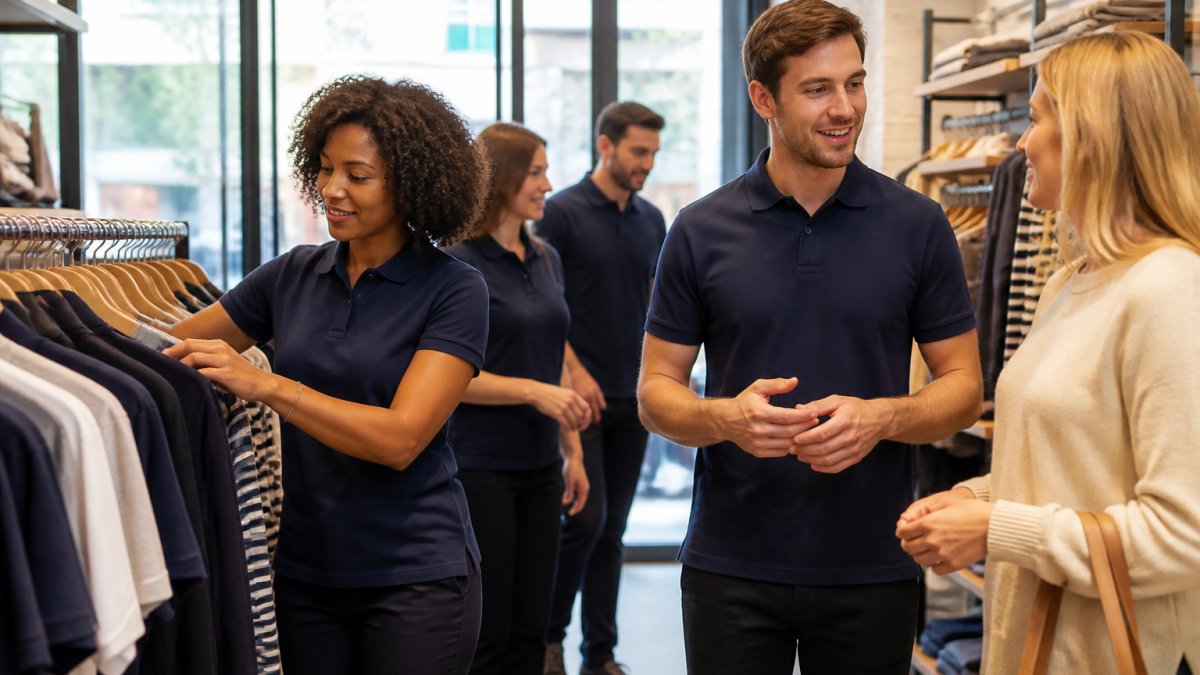
The branded polo shirt is the workhorse of retail uniforms. It strikes the balance between professional appearance and practical comfort, customers see authority, staff experience breathability. A quality polo works across seasons with layering options and keeps your brand visible without looking corporate or stiff.
The Pro RTX Piqué Polo at £6.25 per unit delivers durability at a realistic price point. Built from poly-cotton piqué tested for 60°C washing, it holds embroidered logos without cracking and maintains shape through repeated industrial laundering. The ribbed collar and taped neck reduce chafing during full-shift wear, a detail that affects staff comfort and retention.

For retail operations with female staff, the Pro RTX Ladies Piqué Polo (£6.58) offers tailored fit without compromising durability. The two-button placket and side vents create shape that works with the female silhouette, and the piqué fabric responds identically to washing as the men's version. This consistency matters when you're ordering multiple sizes across a team, everyone's uniform ages at the same rate.
Bulk ordering these polos at volume pricing cuts unit costs further. For a team of 8-10 staff, a single bulk order covers multiple colour options and sizes without the per-unit premium of small orders.
Bulk Workwear Pricing: Maximising Your Procurement Budget
Bulk workwear pricing is where cost-effective uniforms actually become affordable. The difference between ordering 5 polos and 50 polos isn't linear, volume discounts stack quickly. Understanding how pricing scales helps you plan procurement without overspending.
Most workwear suppliers structure pricing in tiers. Small orders (1-9 units) carry the highest per-unit cost. Orders of 10-49 units drop to a middle tier. Orders of 50+ units unlock trade pricing that makes uniforms genuinely cost-effective. For retail teams, this means batching orders strategically rather than buying piecemeal.
At EG Clothing, we've built our pricing to reward bulk commitment without penalising small teams. The Pro RTX Piqué Polo costs £6.25 per unit for standard orders, but teams ordering 20+ units benefit from volume pricing that reduces the per-garment cost. For a dental practice with 8 staff or a small retail shop with 12 employees, a single coordinated order of 15-20 polos makes financial sense.

Hidden costs erode perceived savings. Some suppliers quote low unit prices but add embroidery charges, setup fees, or rush charges at checkout. When comparing suppliers, ask for the total cost of a sample order including your specific customisation, embroidery placement, thread colour, logo sizing. This reveals the real price.
Payment terms matter for cash flow. Suppliers requiring 50% upfront and 50% on delivery tie up working capital differently than those offering net-30 invoicing. For small retail operations, this distinction affects whether you can afford to reorder uniforms regularly or must stretch replacement cycles.
Durable Uniforms for Retail: Embroidery and Screen Printing That Withstand Washing
Embroidery and screen printing are not interchangeable. Each technique has different durability profiles, and choosing the wrong one for your use case wastes money on uniforms that fade or crack within months.
Embroidery uses thread stitched directly into fabric. It's more durable than screen printing for high-wash environments because stitching physically anchors to the weave. Embroidered logos survive 50+ wash cycles without significant fading or cracking.
Screen printing applies ink to fabric surface. It's faster and cheaper than embroidery, making it ideal for large orders where cost per unit matters most. However, screen-printed logos on lower-quality fabrics crack and fade after 15-20 washes. On quality piqué fabric, screen printing lasts longer because the structured weave supports the ink layer.
Pro RTX Piqué Polo T-Shirt, 60°C Wash →
The decision hinges on wash frequency and garment lifespan. Retail uniforms worn 5 days per week and washed weekly will see 50+ wash cycles per year. Over a 2-year lifespan, that's 100+ washes. Embroidery justifies its higher upfront cost because the logo remains legible throughout.
In-house embroidery and printing services matter more than most retailers realise. When your supplier handles customisation on-site, quality control is tighter and turnaround is faster. At EG Clothing, our in-house embroidery team ensures consistent logo placement across every garment in your order.
Customisation Options: Logo Placement and Brand Consistency
Logo placement and sizing directly affect how professional your uniforms look on the shop floor. A logo placed too high rides into the collar and looks cramped. Placed too low, it disappears under till counters or customer interactions. Consistent placement across every garment in your team reinforces brand identity.
Most retail operations place logos on the left chest, the standard position that reads immediately when customers face your staff. This placement works with embroidery and screen printing equally well. The challenge is maintaining that consistency across multiple orders and sizes. A size small and a size XXL have different chest proportions, so a logo that looks centred on one might sit off-centre on another.
Quality suppliers account for this by using size-adjusted placement guides. Rather than placing every logo at identical coordinates, they adjust slightly for garment dimensions. This ensures the logo appears centred on the wearer regardless of size. Suppliers who don't do this produce visually inconsistent uniforms that undermine your brand.
Colour matching across orders matters for brand consistency. If your first uniform order uses navy blue and your second order uses a slightly different navy, the visual inconsistency is immediately obvious when your team wears mixed batches. Suppliers using batch-dyed fabric from the same mills across orders minimise this problem. Switching suppliers increases the risk of colour drift.
Thread colour for embroidery should contrast with your fabric without clashing. Navy uniforms with gold thread create visual impact. Black uniforms with white thread read clearly from a distance. Avoid embroidery colours that blend into the fabric, a black logo on navy fabric looks muddy on the shop floor.
| Placement Option | Best For | Visual Impact | Consistency Challenge |
|---|---|---|---|
| Left chest | Standard retail | Immediate recognition | Size scaling across XS-XXL |
| Full back | High-visibility branding | Strong from behind | Requires larger logo, higher cost |
| Sleeve | Secondary branding | Subtle, professional | Easy to maintain across sizes |
| Left chest + sleeve | Maximum branding | Strong visual presence | Doubles embroidery cost per garment |
Uniform Lifecycle and ROI: Long-Term Cost Savings
Cost-effective uniforms aren't measured by unit price, they're measured by total cost of ownership over the garment's lifespan.
Calculate your real cost per garment by dividing total spend by expected lifespan in months. A £6.25 Pro RTX Piqué Polo lasting 24 months costs £0.26 per month.

Replacement frequency is your hidden cost. When uniforms fade, crack, or lose shape, staff stop wearing them, either because they look unprofessional or because they're uncomfortable. This forces you to replace them earlier than planned. Quality uniforms that maintain appearance and comfort extend replacement cycles by 6-12 months.
Staff retention connects to uniform quality in ways most retailers miss. A uniform that feels good and looks professional reduces this friction.
ROI calculation for branded uniforms accounts for brand visibility and customer perception. Consistent, professional uniforms increase customer confidence and reduce friction in transactions. This translates to higher average transaction values and repeat visits, measurable business outcomes that justify uniform investment.
For a small retail operation, the ROI timeline is typically 6-12 months. If uniforms cost £150 per employee and last 2 years, the monthly cost per employee is £6.25.
Conclusion
Cost-effective branded uniforms for retail require balancing upfront investment against durability and replacement frequency. Quality fabrics like poly-cotton piqué, in-house embroidery services, and strategic bulk ordering transform uniforms from an expense into a brand asset that pays dividends through improved customer perception and staff retention.
At EG Clothing, we've spent a decade helping retail teams find this balance. Our in-house embroidery and fast turnaround mean your uniforms are ready when you need them, not months later. With our trade pricing and commitment to quality, your team gets professional branded workwear that lasts. Start branding your retail uniforms with EG Clothing and see how consistency builds customer trust.
Frequently Asked Questions
What makes a work uniform cost-effective for retail?
A cost-effective uniform balances upfront purchase price with durability and maintenance costs. Fabrics like poly-cotton blends withstand repeated 60°C washing without fading or losing shape, reducing replacement frequency. Bulk ordering reduces per-unit costs significantly. Uniforms that hold embroidery well after multiple washes avoid costly re-branding. Total cost of ownership, not just initial spend, determines true value.
Is it cheaper to buy branded uniforms in bulk?
Yes. Bulk orders unlock volume discounts that lower per-garment costs substantially. For example, the Pro RTX Piqué Polo starts at £6.25 per unit; larger orders typically reduce this further. Bulk procurement also consolidates shipping and embroidery setup fees across more items.
How can retailers add a logo to staff uniforms without it cracking after washing?
Quality embroidery on durable fabrics is key. The Pro RTX Piqué Polo uses reinforced poly-cotton construction and is tested to withstand repeated 60°C washes while retaining embroidery definition. In-house embroidery services ensure consistent stitch tension and thread quality across batches. Screen printing also works well on structured fabrics but embroidery generally holds better on high-wash-frequency uniforms used in retail.
Which fabrics are best for retail staff uniforms that need frequent washing?
Poly-cotton blends (65% polyester, 35% cotton) offer the best balance for retail. They resist shrinkage, maintain colour after repeated 60°C washing, and hold embroidery securely. Piqué weaves add structure and durability. Heavy cotton options work for lower-wash environments but shrink and fade faster than blends. Avoid 100% cotton for high-frequency laundering; it loses shape and fades quicker, increasing replacement costs.