

Last Updated: October 23, 2026
Quick Summary
Embroidery vs printing uniforms comes down to durability: embroidery typically outlasts printing by a significant margin, remaining legible through hundreds of wash cycles while screen printing lasts 50-100 washes and DTF printing lasts 100-200 washes before visible fading or cracking appears. Choose embroidery for high-durability applications like healthcare and construction uniforms washed frequently over 1-2 years, or printing for lower-cost branding when uniforms are replaced within 50-75 washes.
- Embroidery thread doesn't fade and resists degradation through hundreds of wash cycles, while printed logos show visible fading after 30-150 washes depending on print type.
- Screen printing lasts 50-100 wash cycles; DTF printing lasts 100-200 cycles; embroidery remains nearly identical after 300 washes.
- Poly-cotton blend fabrics perform better for embroidery than pure cotton because they shrink uniformly and provide structural stability for stitching.
- Washing embroidered uniforms at lower temperatures with gentle cycles and air drying extends longevity significantly compared to high-heat industrial washing.
- Embroidery becomes more economical than printing when uniforms exceed 100-150 total wash cycles, typically 1-2 years of weekly washing.
Table of Contents
- Embroidery vs Printing: Key Differences in Durability
- Which Lasts Longer: Embroidery or Printing on Uniforms
- DTF vs Screen Printing for Uniforms: Which Holds Up Better
- Best Fabric for Uniform Embroidery: Choosing the Right Base
- How to Wash Embroidered Workwear: Protecting Your Investment
- Durability by Garment Type and Use Case
- Cost and Longevity: Total Service Life Comparison
- Frequently Asked Questions
Embroidery vs Printing: Key Differences in Durability
When you're choosing how to brand uniforms for your team, the durability question comes down to understanding embroidery vs printing uniforms and which technology suits your needs. At EG Clothing, we've worked with businesses across healthcare, construction, and hospitality to understand which method actually holds up under real-world conditions.
Embroidery and printing approach the problem differently. One uses thread stitched directly into fabric; the other bonds ink or film to the surface. These fundamental differences create distinct durability profiles, and understanding them helps you avoid costly mistakes when ordering uniforms for your staff.
How Embroidery Works on Fabric
Embroidery deposits thread through the fabric using a needle and bobbin system. The thread passes through the material, creating a raised, textured design that sits slightly above the garment surface.
The key advantage here is permanence. Once thread is stitched into a garment, it cannot separate from the fabric without actually cutting the thread.
However, embroidery has limitations. Fine detail work, small text, thin lines, intricate shading, becomes difficult because thread has thickness. A logo with five colours requires five separate thread passes, which increases setup time and cost.
How Printing Works on Fabric
Printing applies ink or film directly to the garment surface using heat and pressure. Screen printing forces ink through a mesh template onto fabric.
Printing excels at complexity. Photographic images, gradients, fine detail, and unlimited colour combinations are straightforward. A logo with dozens of colours costs the same as a single-colour design.
The trade-off is adhesion. Ink bonds to fabric through heat and pressure, but that bond can weaken over time. Repeated washing, friction, and flexing of the garment gradually stress the ink layer.
Which Lasts Longer: Embroidery or Printing on Uniforms
The honest answer: embroidery typically outlasts printing by a significant margin, but "typically" masks important details. Durability depends on the specific print technology, fabric choice, washing method, and intended use.
Embroidery Longevity Under Wear and Tear
Embroidery remains legible and intact through hundreds of wash cycles. The thread itself doesn't degrade from normal laundering. What can damage embroidery is mechanical stress: snagging, catching on sharp objects, or repeated friction in the same spot.
Embroidered designs hold colour permanently because thread doesn't fade like ink does. A navy thread stays navy regardless of washing or sunlight. This matters for high-visibility workwear, where colour retention directly affects safety compliance.
The weakness emerges when garments receive industrial washing at high temperatures. The Pro RTX Piqué Polo T-Shirt at EG Clothing is specifically tested to withstand 60°C machine washing without stitching degradation, this is the kind of durability verification that matters for workwear programs.

Printing Longevity and Fading Patterns
Screen printing typically lasts 50-100 wash cycles before visible fading or cracking becomes apparent. The ink layer gradually breaks down as detergent molecules penetrate the surface, and heat from washing stresses the bond between ink and fabric.
DTF printing performs better than screen printing in durability tests, often lasting 100-200 washes before noticeable degradation. The film layer is thicker and bonds more completely to the fabric surface.
Colour fading in printed designs follows a predictable pattern. Light colours fade first and most obviously. A white logo on a dark shirt becomes noticeably pale after 30-40 washes.
DTF vs Screen Printing for Uniforms: Which Holds Up Better
DTF printing has emerged as a more durable alternative to traditional screen printing, but "more durable" is relative.
In practice, DTF designs resist cracking better than screen printing. They maintain colour saturation longer. They handle repeated washing without the gradual ink breakdown that screen printing experiences.
But DTF still underperforms embroidery for long-term durability. After 150-200 washes, DTF logos begin showing visible wear.
The practical implication: if your uniforms will be washed more than 100 times during their service life, embroidery delivers better value despite higher upfront costs.
Best Fabric for Uniform Embroidery: Choosing the Right Base
Embroidery durability depends partly on the fabric you choose. Not all fabrics support embroidery equally well.
Fabric Weight and Embroidery Success
Heavier fabrics hold embroidery better than lightweight ones. A 200gsm piqué weave provides stable structure for stitching.
Lightweight fabrics, thin cotton knits, single-ply materials, allow embroidery thread to pull the fabric, creating visible puckering around the logo. The stitching may also compress the fabric, making the design appear sunken rather than raised.
The Pro RTX Pro T-Shirt uses a cotton-blend fabric designed for printing and embroidery. The Pro RTX Piqué Polo is specifically engineered as a piqué weave, which provides the structural support that embroidery requires.

Blended Fabrics vs Pure Cotton
Poly-cotton blends perform better for embroidery than 100% cotton. The polyester fibres add structural stability and reduce shrinkage.
Pure cotton shrinks unevenly, particularly at different temperatures. A 100% cotton shirt washed at 60°C might shrink differently than one washed at 40°C, creating stress on the embroidered design. Poly-cotton blends minimise this problem.
For high-visibility workwear like the Pro RTX High Visibility Polo Shirt, polyester blends are standard because they also resist UV fading better and dry faster in industrial washing cycles.
Pro RTX Piqué Polo T-Shirt, 60°C Wash →
How to Wash Embroidered Workwear: Protecting Your Investment
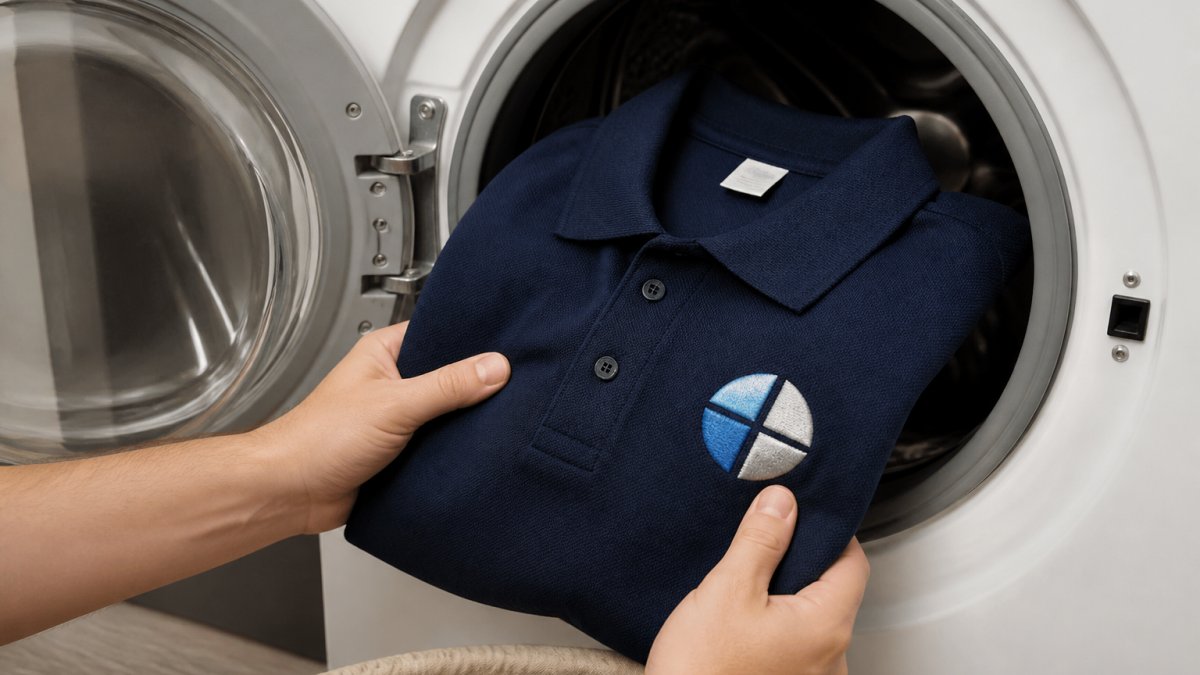
Proper care extends embroidery durability significantly. The difference between a logo that looks sharp after 200 washes and one that looks worn after 100 washes often comes down to washing method.
Industrial Washing and Embroidery Damage
Industrial washing machines operate at higher temperatures and with more aggressive agitation than home washing. A 60°C industrial wash cycle is hotter and more turbulent than a 60°C home cycle.
The solution is using a gentle cycle even in industrial settings. Wash embroidered uniforms at the lowest effective temperature, and use a delicate or reduced-agitation setting. This preserves embroidery integrity while still removing soils and bacteria.
Drying method matters too. High-heat tumble drying can stress embroidery stitching. Line drying or low-heat drying extends embroidery lifespan.
Care Instructions for Printed Uniforms
Printed designs require different care. Washing inside-out reduces friction between the print and washing machine walls. Cooler water (30-40°C) slows ink degradation. Gentle cycles reduce mechanical stress on the ink layer.
Drying temperature is critical for printed uniforms. High heat accelerates fading and can cause cracking at design edges. Air drying preserves print durability far better than tumble drying.
For DTF-printed uniforms, avoid chlorine bleach, which breaks down the film layer. Oxygen-based stain removers are safer. These care differences mean printed uniforms require more careful laundry protocols than embroidered ones.
Durability by Garment Type and Use Case
The best branding method depends on how the uniform will actually be used. Different industries and roles have different durability demands.
Embroidery and Printing for High-Visibility Workwear
High-visibility workwear requires colour retention for safety compliance. A faded logo on a high-vis vest might still be visible, but a faded reflective stripe could become a safety hazard. Embroidery is the stronger choice here because thread doesn't fade.
The Pro RTX High Visibility Waistcoat uses durable polyester and is designed for embroidered branding.
However, high-vis workwear often requires complex designs or multiple colours. If your logo needs photographic elements or gradients, DTF printing might be necessary despite its durability limitations. In that case, plan for more frequent replacement cycles.
Healthcare and Hospitality Uniform Branding
Healthcare uniforms, scrubs, tunics, polos, are washed frequently and often at high temperatures due to infection control protocols. A dental practice or hospital might wash uniforms 2-3 times per week, reaching 100+ wash cycles annually.
Embroidery is the standard choice for healthcare workwear. The Unisex Scrub Top from EG Clothing is designed for clinical settings where durability and professional appearance matter. Embroidered logos withstand the high-temperature washing that infection control requires.
Hospitality uniforms (restaurant, hotel, retail staff) typically receive gentler washing and lower replacement rates. Printed logos are acceptable here because uniforms might only reach 50-75 washes before being retired.
Cost and Longevity: Total Service Life Comparison
The durability question cannot be separated from cost. Embroidery costs more upfront but lasts longer.
Over a single order, printing appears cheaper. Over the garment's complete service life, the calculation changes.
If a uniform is washed 200 times before retirement, embroidery delivers better value.
EG Clothing offers both embroidery and printing services, and the choice depends on your specific use case.
Choosing between embroidery and printing for your team's uniforms means balancing durability, appearance, complexity, and cost.
The real decision hinges on how long you expect your uniforms to last and how often they'll be washed.
Frequently Asked Questions
Which lasts longer on uniforms: embroidery or printing?
Embroidery generally outlasts most printing methods on uniforms, especially with industrial washing. Embroidered logos resist fading and maintain definition through repeated 60°C washes because thread sits on top of the fabric rather than penetrating it. The Pro RTX Piqué Polo (£6.25) is tested to withstand 60°C washing with embroidery that retains legibility, making it ideal for high-turnover workwear.
What is the best fabric for uniform embroidery?
Heavyweight, tightly woven fabrics with a structured weave, such as piqué cotton-polyester blends, perform best for embroidery. These fabrics provide a stable base that prevents thread from pulling through or puckering. Avoid lightweight single-knit cottons, which lack the density to support dense embroidery without distortion. The Pro RTX Piqué Polo uses a durable poly-cotton piqué blend specifically chosen for embroidered branding, and the Pro RTX Hoodie's cotton-rich blend with twin-needle stitching reinforces seams to handle the stress embroidery places on fabric.
How should you wash embroidered and printed uniforms?
Embroidered uniforms tolerate 60°C machine washing and industrial laundering well; turn garments inside-out to reduce abrasion on the stitching. Always check the care label for your specific branding method.
Is DTF printing better than screen printing for workwear durability?
For uniforms requiring maximum durability, embroidery or high-quality screen printing on heavyweight fabrics like the Pro RTX range offers longer service life.
Will frequent industrial laundering affect uniform printing?
Yes, frequent industrial laundering, especially at 60°C with heavy agitation, accelerates fading and deterioration of most printing methods. Embroidery is the most resistant to industrial laundering, as thread does not fade or peel like ink. If your uniforms go through high-turnover industrial laundry cycles, embroidery or premium screen printing on robust fabrics like the Pro RTX Piqué Polo offers significantly longer durability.
Can embroidery crack or fray on workwear uniforms?
Embroidery can fray or show thread breakage if the base fabric is too lightweight or if the embroidery density is excessive relative to the fabric weight. Fraying occurs when the fabric cannot support the tension of the stitching, causing threads to pull through or loop. This is why heavyweight, tightly woven fabrics like piqué blends perform better than lightweight cottons. Proper garment construction, such as reinforced seams and taped necks on the Pro RTX Piqué Polo, reduces stress on embroidered areas and extends the life of the branding significantly.
Which branding method is best for high-visibility workwear?
Embroidery is often preferred for high-visibility workwear because it does not affect the visibility properties of reflective tape or fluorescent fabric. Printing, particularly DTF or heat-transfer methods, can obscure or degrade the reflective surface if applied over safety tape. Screen printing is acceptable if done carefully away from reflective elements. The Pro RTX High Visibility Waistcoat (£3.28) and High Visibility Polo (£11.47) are designed to work with embroidered or screen-printed logos while maintaining their safety compliance and visibility features.
