

Table of Contents
- Start With Dental Uniform Requirements
- Pick the Best Fabric for Medical Scrubs
- Get the Fit Right: Sizing, Movement and Long Shifts
- Choose Dental Uniform Colours That Work for the Whole Team
- Match Garments to Each Role: A Selection Framework
- Order Embroidered Dental Uniforms Without Placement Drift
- Work Out Total Cost of Ownership
- Washing, Care and Garment Lifespan
- Frequently Asked Questions
Last Updated: October 18, 2026
Start With Dental Uniform Requirements
Choosing professional dental uniforms starts with the requirements of the job, not the catalogue. Dental work means long shifts, close patient contact and frequent washing, so your uniform must survive all three.
Define your requirements before you shop:
- Does the fabric cope with frequent high-temperature washing?
- Can staff move, bend and sit without restriction?
- Are pockets deep enough for instruments and pens?
Score every option against them. It sounds basic, but it stops most bad purchases.
Infection Control and Laundering Expectations
Uniforms in clinical settings should be washed at a temperature high enough to reduce contamination risk, and changed daily. The Department of Health guidance on uniform and workwear sets out the expectation that clinical uniforms are laundered separately from household washing and at appropriate temperatures.
That has a direct buying consequence. A garment that shrinks or fades at 65°C is not fit for a dental setting, however good it looks on day one.
Pick the Best Fabric for Medical Scrubs
The best fabric for medical scrubs is a polyester-cotton blend around 195GSM. That weight holds its shape through repeated washing, resists wrinkling and stays comfortable across a full shift.
Our clinical tunics, including the Behrens Male Dental Tunic, use a 195GSM 65% polyester, 35% cotton blend.

The finish matters as much as the fibre: vat-dyed fabric holds colour far better than surface-dyed alternatives, which is why our tunics keep their shade after repeated washes.
Weight, Stretch and Breathability
Weight and breathability pull against each other. Heavier fabric lasts longer; lighter fabric breathes better. For a dental surgery at a comfortable room temperature, midweight wins.
Look for:
- Breathability: a poly-cotton blend that lets heat out during long procedures
- Stretch or ease: action back pleats or vents rather than elastane, which degrades with heat
- Quick-dry behaviour: uniforms washed in the evening and needed the next morning
Get the Fit Right: Sizing, Movement and Long Shifts
Fit is where most uniform orders fail. A tunic that pinches at the shoulder or rides up when seated will be quietly abandoned.
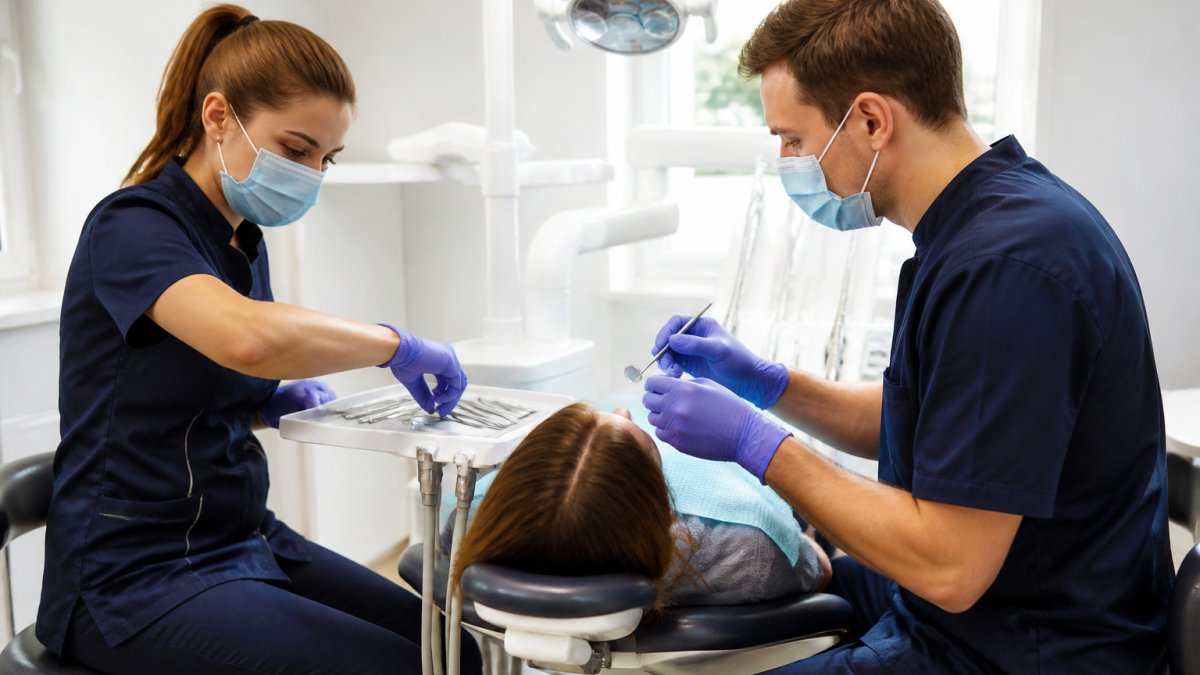
Our advice: ask staff to try on with a colleague present and perform three movements. Sit down. Reach across the body. Raise both arms. If any of those pull, size up or choose a design with an action back.
For inclusive sizing, take fresh measurements rather than asking staff for their usual size. Sizing varies between suppliers, and a fit testing session removes most of the guesswork.
Choose Dental Uniform Colours That Work for the Whole Team
Dental uniform colours should do two jobs: look professional and hide the everyday marks of clinical work. Navy and royal blue are the safest choices, with green a popular calmer alternative; white looks crisp but shows every splash.
Start from what the fabric will look like after fifty washes, not on day one. Colour fastness matters more than the shade chart: a mid-blue vat-dyed tunic still reads as the same blue two years later, while a cheap surface-dyed one fades to a patchy grey-blue.
Build a palette, not a colour list
A coordinated palette reads as organised to patients and makes staff easy to identify. A workable structure:
- Navy or royal blue for clinical staff, the most forgiving base and the easiest to reorder consistently
- A single accent colour for trim, embroidery or piping, used identically across every garment
- A distinct shade for reception or non-clinical roles, so patients can tell clinical from administrative staff at a glance
The accent colour is where most practices come unstuck. "Bottle green" from one supplier is not "bottle green" from another, and a reorder six months later can arrive a shade off. Fix the accent to a thread code and a Pantone reference, and keep both on file with the embroidery spec.
Match colour to role and to the room
Colour choice should follow the task, not the trend:
| Role | Suggested base | Reasoning |
|---|---|---|
| Dentist | Navy or royal blue tunic | Professional, forgiving of instrument marks, reads as senior |
| Dental nurse | Navy or mid-blue tunic or scrub set | Hides chairside splashes, coordinates with dentist |
| Hygienist | Mid-blue or green scrub set | Calmer palette for longer appointments, easy to spot |
| Reception | Distinct shade or smart top | Separates non-clinical staff, patient-facing presentation |
| Decontamination staff | Dark scrub set | Hides marks, practical, no loose cuffs |
Then check the colour against the surgery itself: a pale tunic against a pale wall looks washed out under clinical lighting, and a very dark tunic can look heavy in a small room. Hold a fabric swatch against the wall and chair in the actual surgery before you order.
Keep the palette consistent across reorders
A team palette only works if it stays the same. Three practical controls:
- Record the shade reference, supplier colour name, Pantone or thread code, and dye method, in the same file as your embroidery spec.
- Order sets, not singles, so tops and trousers are dyed in the same batch and cannot arrive a shade apart.
- Buy a small buffer stock in the most common sizes, so a new starter in month eight is not wearing a visibly different blue from the rest of the team.
Finally, colour is a laundering decision as much as a design one. A colour that fades at 65°C is a future mismatch. Check the wash label and dye method together before committing the whole practice to a shade.
Match Garments to Each Role: A Selection Framework
A role-by-role framework stops the uniform order becoming a free-for-all. Use this:
| Role | Garment | Why |
|---|---|---|
| Dentist | Dental tunic or dentist top | Professional look, instrument pockets |
| Dental nurse | Tunic or scrub set | Movement, easy laundering |
| Hygienist | Scrub top and trousers | Freedom of movement, quick changes |
| Reception | Tunic or smart top | Patient-facing presentation |
| Decontamination staff | Scrub set | Practical, washable, no loose cuffs |
Start from the task, then choose the garment: a dentist moving between surgery and consultation benefits from a tunic with a waterproof-lined pocket, while a chairside nurse may prefer a scrub set.
Order Embroidered Dental Uniforms Without Placement Drift
Embroidered dental uniforms only work if the logo lands in the same place every time. Placement drift between batches is the most common complaint we hear from practices switching suppliers, and it is entirely avoidable. But embroidery is only one part of a practice-wide uniform order, the bigger job is turning a uniform choice into a policy the whole practice can follow for years.
Fix the embroidery spec before the first order
Ask for a placement spec before production: exact position in millimetres from the shoulder seam and centre line, thread colour code, and a digital proof. Keep it on file and every reorder matches the first. Our in-house embroidery and print service holds the spec in one place.
A workable spec covers:
- Position: left chest, measured in millimetres from the shoulder seam and centre line
- Size: logo width and height in millimetres, fixed for every garment type
- Thread: a named thread code, not a colour description
Build a practice-wide uniform policy
A uniform policy is what stops the order becoming a free-for-all. It does not need to be long, but it should cover:
- Who wears what: the role-by-role garment and colour framework, written down
- When uniforms are changed: daily for clinical staff, and where staff change (on site rather than travelling home in uniform)
- How uniforms are laundered: the temperature, the separation from household washing, and who is responsible
Staff input matters more than most practices expect. A uniform that staff have tried and commented on is worn properly; one imposed without consultation is quietly altered, covered or abandoned. Run a fit testing session with a sample in the middle of your size range, have three staff of different builds try it, and record the feedback before the full rollout.
Plan stock, replacement and reorders
Procurement is where uniform budgets quietly leak. Plan for:
- Buffer stock in the most common sizes, so a new starter is not waiting weeks for a garment
- Replacement cycle: know how often garments are retired and budget for it rather than reacting
- Re-embroidery cost: every replacement garment needs the logo again, so factor it into the per-garment cost
Run the numbers on total cost of ownership rather than headline price. Our trade pricing and UK stock keep the reorder side simple.
Keep the policy alive
A uniform policy written once and never reviewed drifts out of date. Review it annually, or whenever the team changes significantly, and check three things: whether the palette still matches across the team, whether the size range still fits your staff, and whether the laundering routine is actually followed.
Work Out Total Cost of Ownership
The cheapest tunic is rarely the cheapest uniform. Total cost of ownership means price per garment divided by the washes it survives, plus replacement and re-embroidery costs.
A tunic at £19.30 that lasts two years beats a cheaper one replaced every eight months. Add the cost of re-embroidering replacements and the gap widens.
Run the numbers on:
- Cost per wear: price divided by shifts worn per year
- Replacement rate: how often garments are retired
- Re-embroidery: charged again on every replacement
Our trade pricing and UK stock keep the reorder side simple, which matters more than a headline price.
Washing, Care and Garment Lifespan
Garment lifespan is set by how you wash, not just what you buy. Wash clinical uniforms separately at the highest temperature the label allows, avoid fabric softener, and never overload the machine.
A simple care routine:
- Change out of uniform before leaving the practice
- Wash separately from household laundry
- Use the labelled temperature, up to 65°C where specified
- Skip fabric softener, which coats the fabric
- Air dry or tumble on low to protect the finish
- Check seams and embroidery monthly
Look after them this way and a 195GSM poly-cotton tunic will hold its colour and shape for years. Neglect them and even good fabric fails early.
Frequently Asked Questions
What should you look for when choosing dental uniforms?
Look for four things: a fabric that survives high-temperature washing, a fit that lets you sit and reach without pinching, pockets that keep instruments and notes secure, and a colour your team can agree on. Check the wash temperature on the care label against your practice's infection-control policy before you buy. A 65% polyester, 35% cotton blend at around 195GSM is a practical starting point because it holds shape and colour through repeated washes.
What is the best fabric for dental scrubs?
A poly-cotton blend is the workhorse choice for dental scrubs. The 65% polyester, 35% cotton mix used in clinical tunics and scrub tops resists shrinkage, keeps its colour after repeated washing and dries faster than pure cotton. Weight matters too: 195GSM fabric is heavy enough to drape neatly and hold pockets without feeling stiff. If you want a softer feel, look for stretch fabric, but check it still meets your laundering temperature requirements.
Can dental uniforms be embroidered with a practice logo?
Yes. Embroidered dental uniforms are common in practices that want a consistent, professional appearance across the team. The main thing to agree before ordering is placement: specify the exact position and size on the chest or sleeve so repeat orders match. Ask your supplier to keep the embroidery file on record, and request a sample garment first. Consistency between batches depends on the same digitised file being reused, not recreated each time.
How many sets of dental uniforms should a dental professional own?
Three sets per person is a sensible minimum: one worn, one in the wash and one ready. If your practice washes uniforms on site at 65°C or above, two sets can work, but staff who launder at home usually need three to avoid running out. For a team of eight, that means 24 sets in circulation, which is worth factoring into your total cost of ownership before you compare prices.
Getting dental uniforms right comes down to requirements, fabric and fit, in that order. Most practices that struggle have skipped straight to colour. If you want the process handled end to end, EG Clothing offers in-house embroidery, UK stock, trade pricing and a free trial so you can test fit before committing. Start branding your team with uniforms built to survive clinical life.