

Table of Contents
- Why Embroidery Fades: The Science Behind Colour Loss
- Best Laundry Practices for Embroidered Workwear
- How to Wash Embroidered Uniforms Without Damaging Logos
- Drying and Storing Uniforms to Protect Embroidery
- Maintaining Logo Consistency on Uniforms Across Multiple Orders
- Thread Type Durability and Restoration Techniques for Faded Embroidery
- Conclusion: Protect Your Brand, Extend Uniform Life
- Frequently Asked Questions
Last Updated: September 25, 2026
Why Embroidery Fades: The Science Behind Colour Loss
Embroidery fading is the gradual loss of thread colour caused by dye breakdown, fibre damage, and repeated mechanical stress during washing.
- UV light breaks the chemical bonds in dye molecules
- Heat opens fibre pores and lets dye leach out
- Friction wears away the outer fibre layer
Chemical Reactions That Break Down Thread Dye
Most embroidery thread uses dye held by chemical bonds. Chlorine bleach oxidises those bonds and shifts colour permanently; oxygen-based bleaches are gentler but still strip colour over time.
How Industrial Wash Cycles Accelerate Damage
Industrial wash cycles use higher temperatures, stronger agitation, and longer cycles than domestic machines. Agitation rubs thread against fabric thousands of times per cycle, heat softens the thread coating, and detergent lifts dye from weakened fibres. Run that loop weekly and a logo can lose noticeable depth within months.
Best Laundry Practices for Embroidered Workwear
The best laundry practices for embroidered workwear come down to three things: turn garments inside out, wash at 40°C or below, and use a mild, pH neutral detergent.
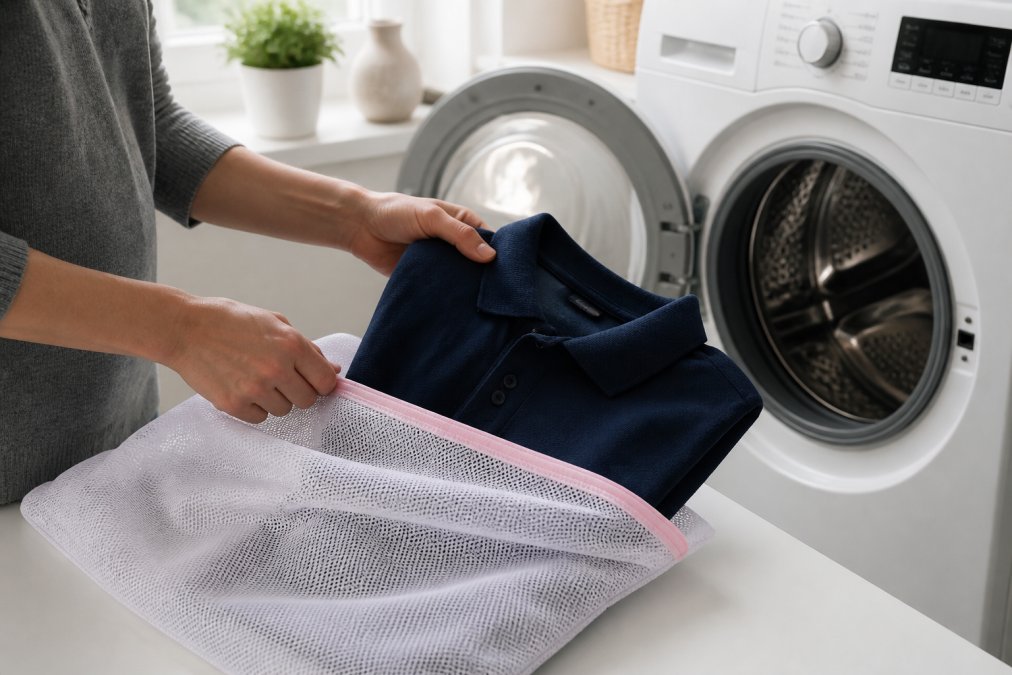
Washing Inside Out and Using Mesh Laundry Bags
Turning a garment inside out puts fabric between the embroidery and the drum, cutting abrasive contact dramatically.
Choosing the Right Water Temperature and Mild Detergent
Lukewarm water, around 30°C to 40°C, is the sweet spot; hot water speeds dye loss and can shrink backing, while cold settings suit lightly soiled uniforms.
How to Wash Embroidered Uniforms Without Damaging Logos
The answer to how to wash embroidered uniforms without damaging logos is a consistent process, not a special product. Follow the same steps every time and the embroidery holds its colour and shape far longer.
Step-by-Step Washing Guide
- Check the garment care label before anything else. It sets the maximum temperature and any restrictions.
- Empty all pockets and close zips, hooks, and Velcro to prevent snagging.
- Turn the garment inside out so the embroidery faces inward.
- Place it in a mesh laundry bag if the logo is dense or the fabric is delicate.
- Sort by colour to prevent colour run from darker garments.
- Set the machine to 30°C to 40°C on a gentle or synthetic cycle.
- Add mild, pH neutral detergent and skip fabric softener entirely.
- Run a shorter cycle where possible to reduce mechanical agitation.
- Remove promptly once the cycle ends to avoid damp odours and creasing.
What to Avoid: Fabric Softeners, Bleach and Abrasive Contact
Fabric softener is the single worst thing for embroidered workwear: it coats thread fibres, dulls colour, and weakens the thread-to-fabric bond until the embroidery looks flat.
Watch for abrasive contact too:
- Velcro straps catching on stitching
- Embroidered logos rubbing against rough surfaces
- Metal buckles and tools in the same wash load
Drying and Storing Uniforms to Protect Embroidery
Air drying in shade is the safest method for embroidered uniforms, for two reasons.
Air Drying vs Tumble Dry Low: What Works Best
Air drying wins on colour retention every time. Hang garments inside out on a line or airer, away from direct sunlight, so incidental light hits the fabric backing rather than the thread.
| Drying Method | Colour Impact | Risk Level | Best For |
|---|---|---|---|
| Air dry in shade, inside out | Minimal fading | Low | All embroidered uniforms |
| Air dry indoors on an airer | Minimal fading | Low | Dense logos, delicate fabrics |
| Air dry in direct sun | Noticeable fading | High | Not recommended |
| Tumble dry low | Slight fading | Medium | Occasional use, time pressure |
| Tumble dry high | Severe fading | Very high | Avoid entirely |
Storage Tips for Uniforms Between Shifts
Storage is where a lot of avoidable fading happens, because uniforms sit in the same place for days between shifts. Three factors matter: light, moisture and pressure.
Pro RTX Piqué Polo T-Shirt, 60°C Wash →
- Keep garments in a cool, dry cupboard away from direct sunlight. A closed cupboard is better than an open rail near a window. UV exposure is cumulative, and a uniform stored on a sunlit rail fades even when it is not being worn.
- Avoid plastic bags for long-term storage. They trap moisture, which encourages mildew and can cause dye to migrate. If you need dust protection, use a breathable cotton or non-woven cover.
- Fold so the embroidered logo faces inward. This protects the stitching from abrasion against other garments and from light.
- Do not hang by the collar. Hanging stretches the neckline and pulls on embroidery near the shoulders. Fold flat, or hang from the shoulders on a broad hanger if the garment must be hung.
- Rotate uniforms between shifts to spread wear evenly across a set. A uniform worn and washed every day ages roughly five times faster than one in a five-garment rotation.
- Store clean and fully dry. Residual detergent or moisture in stored fabric can accelerate dye loss and cause odour.
Maintaining Logo Consistency on Uniforms Across Multiple Orders
Maintaining logo consistency on uniforms across multiple orders is where most suppliers fall short. Thread shade, stitch density, and digitised artwork all drift between batches if nobody controls them, a logo identical on order one and order ten is a deliberate outcome, not luck.
Three things control consistency:
- Digitised artwork file kept on record and reused, never redrawn
- Thread colour codes matched to a standard, not eyeballed
- Stitch density and backing specified once and locked in
Thread Type Durability and Restoration Techniques for Faded Embroidery
Thread choice decides how long a logo lasts, and the reason comes down to fibre chemistry. Polyester is a synthetic polymer with a tightly packed molecular structure, so dye molecules become trapped inside the fibre. Rayon is a regenerated cellulose fibre with a looser structure, and cotton is the loosest of the three, the looser the structure, the more easily water, detergent and UV light reach the dye and pull it out.
Thread type durability comparison:
| Thread Type | Fibre Base | Colour Fastness | Wash Durability | UV Resistance | Best Use |
|---|---|---|---|---|---|
| Polyester | Synthetic polymer | High | High | High | Workwear, high-visibility gear, industrial laundering |
| Trilobal polyester | Synthetic polymer (triangular cross-section) | High | High | High | Logos needing sheen and depth |
| Rayon | Regenerated cellulose | Medium | Low | Low | Decorative, low-wash items |
| Cotton | Natural cellulose | Low | Low | Low | Natural-fibre garments, light use |
Why Some Threads Fade Faster Than Others
Three mechanisms drive the difference:
- Dye penetration depth. Synthetic fibres are dyed during manufacture (solution-dyed) or under pressure, so colour sits throughout the fibre. Natural and regenerated fibres are often dyed after spinning, so colour sits closer to the surface and wears away faster.
- Fibre swelling. Cellulose fibres swell in water, opening the structure and releasing dye. Polyester barely swells, so dye stays locked in.
- UV stability. Polyester's polymer backbone resists UV breakdown. Cellulose fibres degrade under UV, and the dye degrades with them.
A common pattern in commercial laundry is a mixed-thread logo, polyester for the main body, rayon for a highlight, fading unevenly, with the rayon losing depth first. If you control thread specification, specify polyester throughout.
Restoration Techniques for Already-Faded Embroidery
- Re-embroidering over faded stitching. The most reliable fix. A dense new layer of polyester thread covers the faded original, and because the backing and fabric are already in place, the result is usually indistinguishable from new. Best for logos with solid fills rather than fine detail.
- Fabric dye pens and markers. Suitable only for small touch-ups on solid colour blocks. The result rarely matches the original shade exactly, and the colour can bleed into surrounding fabric when the garment is next washed. Test on an inconspicuous area first.
- Thread replacement by a specialist. For high-value garments, an embroiderer can unpick and re-stitch a logo. Labour-intensive, so usually only economic on expensive or low-volume uniforms.
- Patch overlay. A new embroidered patch stitched over the faded logo is a practical rescue for workwear where the original design is no longer available. It also adds a layer of protection to the area underneath.
The UK Health and Safety Executive guidance on protective clothing notes that high-visibility garments must maintain their reflective and colour properties to stay compliant, which makes embroidery care a safety issue, not just an aesthetic one. Faded embroidery on a high-visibility garment is not merely a branding problem, it can affect whether the garment still meets its intended standard.
Conclusion: Protect Your Brand, Extend Uniform Life
Every faded logo sends the wrong message about your business, but most embroidery fading is preventable with cooler washes, mild detergent, shade drying, and a supplier who controls thread and artwork consistency.
Frequently Asked Questions
How can I protect embroidery on clothing during washing?
Turn the garment inside out before washing to reduce abrasive contact on the embroidery. Place it in a mesh laundry bag for extra protection. Use a cold water wash or lukewarm water at 30°C with a mild detergent, and select a gentle cycle with low mechanical agitation. Avoid fabric softeners and bleaching agents, which weaken thread integrity and cause colour run. Following these steps keeps embroidery fading to a minimum and extends uniform longevity.
Does high-heat drying damage embroidered logos on uniforms?
Yes. High heat weakens synthetic fibers and causes natural fibers to shrink, leading to puckering around the embroidery and fiber weakening in the thread itself. Tumble dry low or air dry instead. If you must use a tumble dryer, choose the lowest heat setting and remove the garment while slightly damp. Air drying away from direct sunlight preserves color fastness and prevents the embroidery from becoming brittle or distorted over time.
How do I stop colour fading in dark-coloured work uniforms?
Wash dark uniforms inside out in cold water with a pH neutral detergent. Avoid direct sunlight during drying, as UV exposure breaks down dye molecules and accelerates color bleeding. Use mesh laundry bags to reduce mechanical agitation. For embroidered logos, the same rules apply: cold water wash, mild detergent, and air drying. Pre-treatment of stains should use gentle products rather than bleaching agents, which strip colour from both fabric and thread.
How can I make embroidery more durable for daily industrial use?
Choose garments with higher stitch density and quality embroidery backing, which distribute stress more evenly across the design. Wash at 60°C only when the care label permits, using a mild detergent and avoiding fabric softener. Turn garments inside out and use mesh bags during industrial wash cycles. Inspect embroidery regularly for loose threads or early signs of fading, and address small issues before they worsen. Proper textile maintenance keeps logos sharp through repeated laundering.