

Table of Contents
- Why Brand Consistency Matters in Uniform Orders
- Creating Workwear Brand Guidelines That Stick
- Ensuring Consistent Logo Placement on Uniforms
- Building a Staff Uniform Ordering Checklist
- Uniform Inventory Management Across Locations
- Quality Control and Proofing Between Orders
- Managing Supplier Changes Without Losing Consistency
- Conclusion
- Frequently Asked Questions
Last Updated: October 9, 2026
Why Brand Consistency Matters in Uniform Orders
Maintaining brand consistency across uniform orders sounds straightforward, but it's where many businesses stumble.
Those that maintain strict brand consistency see measurable benefits: teams look more professional, customers perceive them as more reliable, and staff feel proud wearing the brand.
The challenge isn't knowing why consistency matters, it's building a system that keeps it intact across multiple orders, locations, and years.
Creating Workwear Brand Guidelines That Stick
Brand guidelines are your foundation. Without them, every order becomes a negotiation. With them, decisions are automatic.
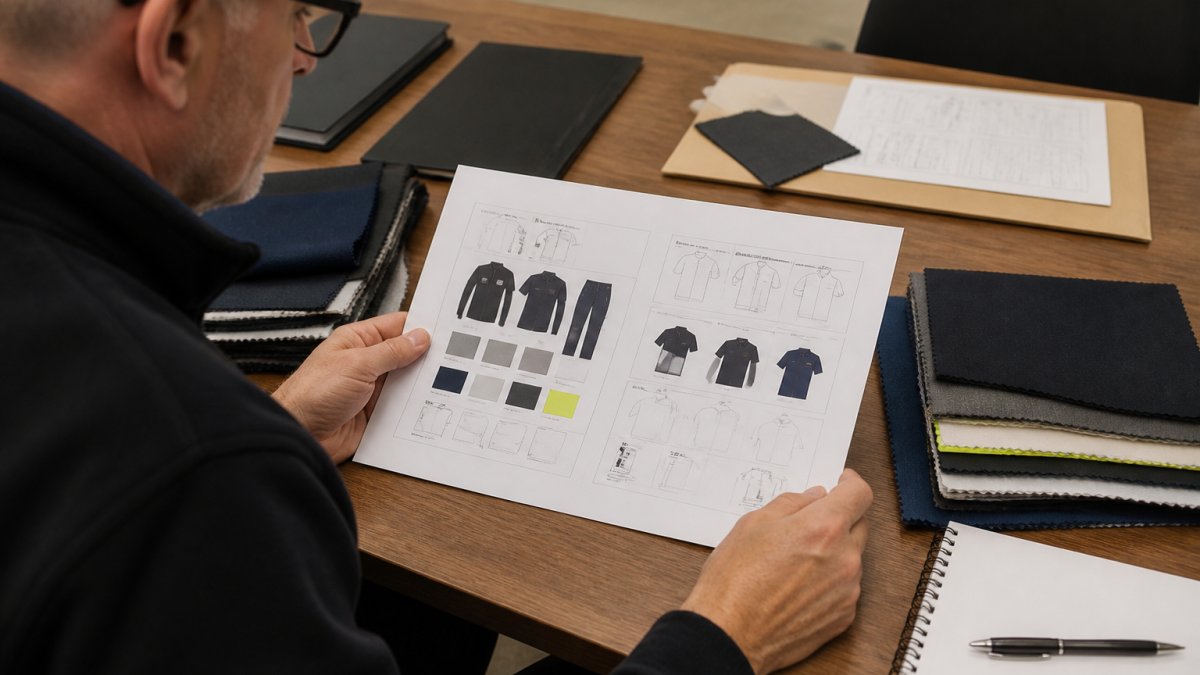
Your guidelines should document:
- Logo specifications (exact sizes, placement, colours)
- Colour palette (specific Pantone or hex codes)
- Approved garment styles and suppliers
Start simple. A one-page visual guide works better than a lengthy text file nobody reads.
Get approval from key stakeholders before finalizing guidelines, operations, finance, and customer-facing staff all have input, and skipping this invites pushback later.
Store your guidelines somewhere accessible, a shared folder, intranet PDF, or office poster, so people actually reference them.
Ensuring Consistent Logo Placement on Uniforms
Logo placement is where consistency breaks down fastest.
Define exact placement measurements.
Communicate these measurements to your supplier in writing. Verbal instructions get misinterpreted; a written specification prevents guesswork.
Request a sample or proof before committing to a full order.
When the full order arrives, inspect the first five garments for logo placement, colour consistency, and embroidery durability.
Keep a reference garment in your office and send it to your supplier when reordering, it removes ambiguity and prevents drift.
Building a Staff Uniform Ordering Checklist
A repeatable ordering process prevents inconsistency. Create a checklist your procurement team follows for every order.
Your checklist should include:
- Garment selection: Which styles are approved? Which colours?
- Sizing breakdown: How many of each size? Who approves the size run?
- Logo specifications: Which logo version? What size and placement?
This checklist becomes your standard operating procedure. Every order follows the same steps. No shortcuts. No assumptions.
Share the checklist with your supplier so both sides know what to expect, preventing misunderstandings and rework.
For the Pro RTX Pro T-Shirt and Pro RTX Piqué Polo T-Shirt, both designed for 60°C machine washing with reinforced embroidery retention, your checklist should specify these wash standards so your supplier knows the durability requirements they're meeting.

| Checklist Step | Owner | Approval Required | Timeline |
|---|---|---|---|
| Define garment styles and colours | Operations Manager | Finance | Week 1 |
| Confirm sizing and quantities | HR or Procurement | Operations Manager | Week 1 |
| Prepare logo and specification document | Marketing or Branding | Operations Manager | Week 2 |
| Submit order with written spec to supplier | Procurement | Finance | Week 2 |
| Receive and approve sample | Operations Manager | Procurement | Week 3 |
| Confirm production | Procurement | Operations Manager | Week 3 |
| Receive full order and inspect | Operations Manager | Procurement | Week 4 |
| Distribute to staff | HR or Logistics | Operations Manager | Week 5 |
Uniform Inventory Management Across Locations
Multiple locations multiply the risk of inconsistency. One site orders from a different supplier. Another substitutes a similar colour because the approved one is out of stock.
The fix isn't just centralising orders, it's controlling the specification and assets behind every order. Consistency holds when three things are locked down: a master specification sheet, a controlled asset library, and a single approval route.
Build a master specification sheet
A master specification sheet is the single source of truth for every uniform order, covering at minimum:
- Garment styles: Approved product codes, fabric weights, and colourways, for example, a specific polo, t-shirt, sweatshirt, and gilet range.
- Colour references: Pantone references for brand colours, plus the closest available garment colour where an exact match is not manufactured.
- Logo files: The exact vector artwork file (for example, an .EPS or .AI file) with a version number and date, so nobody embroiders from an old JPEG.
Keep the sheet version-controlled. When something changes, a new logo version, discontinued garment, or revised placement, update it with the date and reason, and reference the current version on every order.
Control the asset library
Logo files, colour references, and placement diagrams are brand assets. Treat them like it.
- Keep one master folder with read-only access for anyone placing orders.
- Name files clearly, including version and date (for example,
logo-primary_v3_2026-04.eps). - Retire old versions rather than deleting them, so you can trace what was used on a historical order.
This matters most when staff change: a new procurement officer who grabs the wrong file can undo years of consistency in one order.
Centralise ordering and approval
One person or team should place all uniform orders, regardless of location, enforcing the specification and preventing rogue purchases.
But centralising ordering isn't the same as centralising approval. Define who signs off at each stage:
| Stage | Typical owner | Approval needed |
|---|---|---|
| Confirm garment styles and colours | Operations | Brand or marketing |
| Confirm sizing and quantities | HR or site managers | Operations |
| Confirm logo file and placement | Marketing or branding | Operations |
| Approve pre-production sample | Operations | Brand or marketing |
| Approve final delivery | Operations | Procurement |
Adapt the roles to your business, but keep the principle: no order proceeds without a named approver at each gate.
Pro RTX Piqué Polo T-Shirt, 60°C Wash →
Keep an inventory and order log
Track what you ordered, when, from which supplier, in what quantities, and against which specification version. This log does three jobs:
- It shows what is in stock and where.
- It creates a historical record if a batch looks different from an earlier one.
- It supports reorders, because you can hand the supplier the exact previous order reference.
Rotate stock fairly across locations, divide 100 polos evenly across three sites rather than letting one site hoard. Shortages tempt people to buy unauthorised alternatives, which is where inconsistency starts.
Set a reorder trigger, a minimum stock level per site, so replenishment happens before anyone panic-buys.
Handle new locations and onboarding
When you open a new site or onboard staff, resist ordering quickly from whoever is available. Route every new-location order through the same specification sheet, asset library, and approval gates, so a new site looks identical to an established one from day one.
Quality Control and Proofing Between Orders
Quality control isn't a one-time check. It's a process you repeat before every order ships and after every delivery.
Before production begins, request a pre-production sample, a single garment with your logo applied exactly as it will appear on the full order. Inspect it for:
- Logo colour accuracy
- Embroidery or print clarity
- Placement precision
Approve or reject the sample in writing.
When the order arrives, inspect at least five garments from different parts of the production run. Look for:
- Consistency in logo placement across all garments
- Colour matching to your approved standard
- Embroidery durability (check for loose threads or cracking)
Document inspections with photos to create a record and spot trends, if quality declines over time, you'll see it in the photos.
Create an acceptance criteria document. Define what "acceptable" means for your business.
Share this criteria with your supplier. They'll know exactly what standard they're meeting. This removes subjectivity and prevents disputes.
Managing Supplier Changes Without Losing Consistency
Switching suppliers is risky: a new supplier might interpret your specification differently, colours shift, fit changes, and garment ranges get discontinued. Before you switch, or accept a substitution, you need a way to judge whether the replacement matches the approved brand appearance.
Why substitutions happen
Supplier changes rarely arrive as a clean decision. More often they arrive as a problem:
- A garment style is discontinued by the manufacturer.
- A colourway goes out of stock for an extended period.
- A supplier changes ownership, lead times, or minimum order quantities.
Each of these tempts someone to accept "close enough." Close enough is how brand consistency erodes.
Evaluate a replacement garment against fixed criteria
Before accepting any substitution, compare it against your approved reference on:
- Colour: Compare against your Pantone reference under consistent lighting. Note whether the difference is visible side by side. A small shift may be acceptable on a single garment but obvious across a team.
- Fabric and weight: Check the fabric composition and weight. A lighter garment may drape differently and make logos look inconsistent even if placement is identical.
- Fit and sizing: Compare the size run against your existing garments. If a medium from the new supplier fits like a small from the old one, your sizing breakdown is now wrong.
Document the comparison: photograph old and new garments side by side under the same lighting, note the differences and decision, and record why any substitution was accepted so future orders don't silently drift further.
Run a structured trial
When switching suppliers rather than accepting a one-off substitution:
- Order a small trial batch using your exact specification sheet and a reference garment from your current supplier.
- Compare the trial side by side with existing uniforms on colour, fit, embroidery quality, and durability.
- If it passes, place a larger order, but run both suppliers in parallel for a transition period.
- Keep samples and photographs from both suppliers throughout the transition.
- Only retire the old supplier once the new one has delivered at least two consistent orders.
Never switch suppliers mid-order. Finish the current order with the existing supplier, then transition for the next. Mixing suppliers within one order creates visible inconsistency no specification can hide.
Communicate the change internally
If uniforms look slightly different after a supplier or garment change, staff will notice. Explain why it happened, what was evaluated, and how quality was protected, a short note to site managers usually suffices. Silence invites speculation and unauthorised purchases to "fix" the difference.
Update the specification sheet
Every accepted substitution or supplier change should update the master specification sheet: record the new product code, colour reference, and revised placement or durability notes, bump the version number and date, and reference the new version on the next order.
Conclusion
Maintaining brand consistency across uniform orders requires systems, not just good intentions. A clear specification, a repeatable ordering process, and rigorous quality control keep your brand looking professional across every location and order.
EG Clothing helps you build these systems. Our in-house embroidery and printing, fast turnaround times, and UK stock mean you can order with confidence.
Get started with EG Clothing and transform your uniform ordering from a source of inconsistency into a competitive advantage.
Frequently Asked Questions
How do you keep staff uniforms consistent across multiple orders?
Document every specification in a master brand guidelines file: exact colours (using Pantone references), logo placement measurements, embroidery thread colours, and approved garment styles. Share this file with your supplier before each order and request a physical proof sample. When uniforms arrive, inspect a sample from each batch against your master specification. Track any variations and report them immediately. Many businesses assign one person to review all incoming stock against the approved standard to catch drift early.
What should a staff uniform ordering checklist include?
Your checklist should cover garment style and size range, exact colour codes, logo placement (with measurements from seams), embroidery or print method, quantity per item, delivery date, and approval process. Include contact details for your supplier and internal approver, expected lead time, and payment terms. Add a section for quality checks upon arrival: inspect seams, colour match, logo legibility, and washing durability. A detailed checklist prevents misunderstandings and ensures each order matches your brand standards.
Why does consistent logo placement matter on uniforms?
Inconsistent logo placement damages brand recognition and looks unprofessional to customers. If logos sit at different heights or distances from seams across your team, your brand appears disorganised. Specify exact measurements from reference points (e.g., '10cm from shoulder seam, centred on chest') and include a visual diagram with your supplier. Request a pre-production sample before bulk production. This small step prevents batches where logos are misaligned and ensures every team member represents your brand consistently.
What's the best way to manage uniform stock when you're growing or replacing worn items?
Track uniform inventory by style, size, colour, and embroidery variation. Set reorder points based on wear-out rates and staff turnover. Create a simple spreadsheet or stock system that flags when quantities drop below minimum levels. When onboarding new staff, pull from existing stock first to maintain consistency. For replacements, order the same garment style and colour batch as your current uniforms whenever possible. If your supplier changes a product line, test the new version against your old uniforms for colour and fit consistency before ordering in bulk.