

Table of Contents
- Why Logo Embroidery Quality Matters for Your Brand
- How Embroidered Logo Durability Affects Long-Term Value
- Embroidery Versus Printing for Workwear: Why Quality Embroidery Wins
- How to Prepare a Logo for Embroidery: Design Essentials
- Best Fabric for Logo Embroidery: Material Matters
- Quality Control Checklist for Finished Embroidery
- Care and Maintenance: Protecting Your Embroidered Logos
- Frequently Asked Questions
Last Updated: October 17, 2026
Why Logo Embroidery Quality Matters for Your Brand
Poor embroidery quality damages your brand before customers interact with your team.
Logo embroidery quality isn't a luxury detail. It's the foundation of how your brand looks on workwear, and customers draw conclusions about your standards and trustworthiness.
The stakes are highest where appearance signals competence: healthcare, construction, hospitality, logistics.
Quality embroidery does three things:
- Holds its shape through dozens of washes
- Maintains colour and thread integrity under UV exposure and friction
- Keeps logos legible and precise, reinforcing brand recognition every single day
This guide covers what separates durable, professional embroidery from work that falls apart after a season.
How Embroidered Logo Durability Affects Long-Term Value
Durability is where embroidery wins decisively against printing, but only when built to last. A printed logo fades, cracks and peels; an embroidered logo persists through industrial washing, UV exposure and heavy wear, provided thread, stitch density, backing and fabric are specified correctly. Get any wrong and it fails as fast as a cheap print.
What actually determines embroidery durability
Durability is not a single property. It is the product of four interacting choices:
- Thread type and weight. Polyester thread resists UV fading, bleach, and repeated washing far better than rayon, which is softer and shinier but degrades faster under industrial laundry conditions. For workwear washed at 60°C, polyester is the safer default.
- Stitch density. Too few stitches and the design looks sparse and thread shows through; too many and the fabric puckers, the embroidery stiffens, and thread breaks become more likely. Density must be matched to the fabric, not set to a single default.
- Backing (stabiliser). Without adequate backing, stitches pull the fabric out of shape and the logo distorts after washing. Cut-away backing suits stretchy or loosely woven fabrics; tear-away suits stable wovens. The wrong backing is a common cause of early failure.
The true cost per wear
A poorly stitched logo might save a little upfront, but cost per wear, total uniform cost divided by wears before replacement, is what matters.
Quality embroidery is expected to survive repeated 60°C machine washing without thread degradation, friction from movement and daily wear, direct sunlight without colour shift, and stretching and flexing of the fabric underneath.
The Pro RTX Piqué Polo Shirt tested at 60°C wash durability standards demonstrates this durability. Poly-cotton piqué holds embroidery better than lightweight cotton because the weave is tighter and more stable.

Durability by fabric type
Fabric choice changes how embroidery behaves over time, so assess durability per garment:
- Piqué polo shirts and poly-cotton blends: tight, stable weave; hold stitch tension well; suit 60°C washing; a reliable base for frequent-wear uniforms.
- Fleece and knitwear: stretchy and lofted; need appropriate backing and slightly lower density to avoid puckering and distortion; comfortable but less dimensionally stable than piqué.
- Lightweight shirts: thinner fabric; require lighter thread and lower density; prone to puckering if over-stitched.
- Caps: curved, structured panels; embroidery must follow the curve; backing and hooping are critical to avoid distortion.
Matching the embroidery specification to the fabric turns a durable garment into durable branding. The same logo stitched identically across every fabric type will not perform equally.
Embroidery Versus Printing for Workwear: Why Quality Embroidery Wins
Printing suits temporary branding, event wear or high-volume low-durability applications.
Here's why embroidery outperforms printing on uniforms:
Durability: Embroidery is thread on fabric. Printing is ink on a surface. Ink cracks and peels. Thread integrates with the weave.
Colour consistency: Embroidered thread colour doesn't fade like printed ink.
Cost over time: Printing is cheaper initially, but embroidery lasts longer, spreading cost across more wears.
Brand perception: Healthcare, construction, and hospitality professionals expect embroidery. Printing signals budget constraints or temporary status.
For regularly worn workwear, embroidery is the only choice that protects your investment and brand image.
How to Prepare a Logo for Embroidery: Design Essentials
Not every logo works as embroidery. Designs created for print, web or large-format applications often fail in thread, and understanding the constraints before you order saves rework and reorders.
Embroidery-ready logos share these traits:
- Simple, bold shapes with clear outlines
- Minimal fine detail (thin lines disappear at embroidery scale)
- Sufficient contrast between colours
- Legible at small sizes (typically 1.5 to 4 inches wide for workwear)
A logo that looks perfect on a website can become unreadable at a small size; fine lines merge and subtle colour transitions vanish. The design needs rethinking before digitisation.
Digitising: how artwork becomes stitch instructions
Digitising converts a logo into machine-readable embroidery instructions. It is not an automatic file conversion but a skilled interpretation of the artwork, and it is where quality separates from mediocrity.
Those decisions determine whether small text stays readable, whether fine detail survives and whether the fabric puckers. A carelessly digitised logo produces loose stitches and uneven tension no matter how good the garment is.
Stitch density and why it causes puckering
Stitch density, the number of stitches per unit area, directly affects how the embroidery looks and performs.
Puckering is the most common symptom of poor density or inadequate backing: stitches pull more fabric into the design area than it can accommodate.
EG Clothing charges £20.00 for logo digitisation services, which includes stitch density optimisation for workwear fabrics. This single step determines whether your embroidery looks professional or cheap.
Pro RTX Piqué Polo T-Shirt, 60°C Wash →
Common defects and how to resolve them
Most embroidery problems trace back to digitising, density, backing, or machine setup. Knowing the likely cause helps you raise the right question with your supplier:
- Puckering: fabric bunched around the design, usually excessive density or inadequate backing; reduce density or change stabiliser.
- Skipped stitches: gaps where the machine failed to sew, often poor hooping, incorrect tension, or a damaged needle; re-hoop and check tension.
- Thread breaks: frequent snapping, usually too-high density, incorrect thread tension, or a worn needle; adjust tension and replace the needle.
- Poor registration: colours or elements out of alignment, often poor digitising or machine calibration; re-digitise or recalibrate.
Logo size and placement considerations
Embroidered logos on workwear typically range from 1.5 to 4 inches wide.
Placement affects both aesthetics and durability:
- Chest placement (most common): visible, reinforces brand identity, experiences moderate friction
- Sleeve placement: visible during handshakes and interaction, experiences heavy friction from arm movement
- Back placement: large, highly visible, less friction than sleeves
- Collar area: high visibility, but stitching near neck seams can cause irritation
The garment's construction matters: a logo stitched directly onto a seam will eventually fray. Thread needs to pass through stable fabric, not existing stitching or edges.
Placement also affects washing durability: logos on high-friction areas (sleeves, shoulders) wear faster than chest or back placements, though quality embroidery resists this wear better.
Best Fabric for Logo Embroidery: Material Matters
Not all fabrics hold embroidery equally. Weight, weave structure and fibre content determine how well thread integrates and how durable the finished embroidery becomes.
Ideal fabrics for embroidery:
- Piqué cotton or poly-cotton blends (tight weave, stable, professional appearance)
- Twill (durable, holds stitches well, common in workwear)
- Heavy cotton (traditional, durable, though less wrinkle-resistant)
- Poly-cotton blends (wrinkle-resistant, maintains shape, excellent for frequent washing)
Fabrics to avoid:
- Lightweight single-knit cotton (stitches pull through, embroidery puckers)
- Stretchy lycra blends (thread tension inconsistent, embroidery distorts)
- Loosely woven fabrics (thread migrates, seams come loose)
The Pro RTX Piqué Polo Shirt is designed for embroidery: its poly-cotton piqué weave holds thread tension consistently, so embroidery stays flat and precise, and it survives 60°C machine washing without degradation, critical for healthcare and food service uniforms.

Fabric choice affects stitch density and thread type: lightweight fabric needs lighter thread and lower density to avoid puckering, while heavy twill supports denser stitching and thicker thread for bolder logos.
Quality Control Checklist for Finished Embroidery
Before uniforms reach your team, inspect finished embroidery against these criteria to catch defects early and ensure consistency across orders.
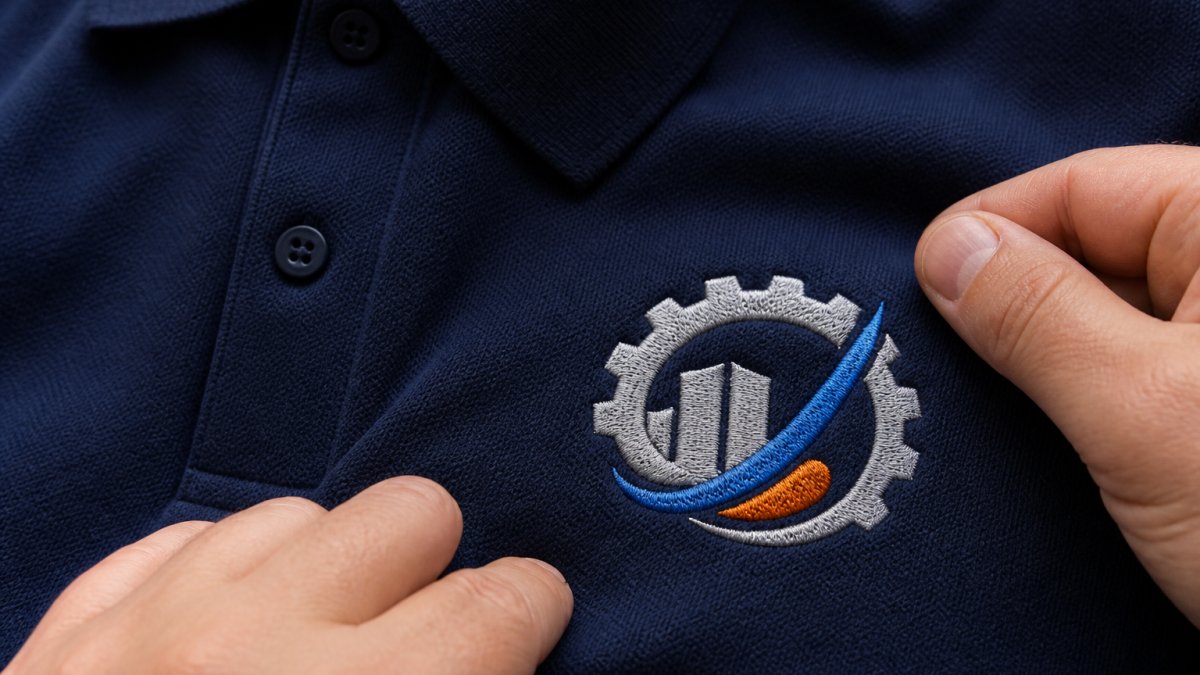
Visual inspection:
- Thread colour matches brand specifications (no fading or discolouration)
- Stitches are uniform in length and tension (no loose loops or tight puckering)
- Logo edges are clean and defined (no fraying or stray threads)
- No gaps or missing stitches in the design
Durability test:
- Gently tug on the embroidery, stitches should not pull loose
- Rub the surface, thread should not shed or pill
- Flex the fabric, embroidery should move with the fabric, not crack or separate
Consistency check (for multiple garments):
- Logo placement is identical across all units (within a reasonable tolerance)
- Thread colour is consistent batch to batch
- Stitch density and appearance match across all garments
Common defects to reject:
- Loose threads or fraying edges (indicates poor finishing)
- Puckering or bunching of fabric underneath (indicates excessive stitch density)
- Faded or discoloured thread (indicates poor thread quality or storage)
- Misaligned or crooked logos (indicates poor digitisation or machine calibration)
Quality control at this stage prevents reorders, replacement costs, and damage to your brand reputation.
Care and Maintenance: Protecting Your Embroidered Logos
Embroidery is durable, but washing method, temperature and detergent all affect how long it stays vibrant and secure.
Best practices for washing embroidered uniforms:
- Temperature: Wash at 60°C maximum. Higher temperatures can weaken thread and cause colour bleeding. Lower temperatures preserve thread integrity longer.
- Cycle: Use a gentle or normal cycle, not heavy-duty. Aggressive agitation accelerates wear.
- Detergent: Use mild detergent. Harsh chemicals fade thread colour and weaken fibres. Avoid bleach entirely.
- Drying: Air dry when possible. Tumble drying generates heat and friction that degrades thread over time. If machine drying is necessary, use low heat.
The Pro RTX Piqué Polo Shirt is tested for 60°C washing, aligning with standard industrial laundry protocols in healthcare and hospitality, and its poly-cotton blend resists shrinkage better than 100% cotton.
What to avoid:
- Dry cleaning solvents (dissolve some thread dyes)
- Ironing directly over embroidery (heat and pressure damage thread)
- Rough handling or excessive wringing
- Storage in direct sunlight
Proper care extends the value of your embroidery investment and maintains consistent brand appearance across your team.
Quality embroidery separates professional workwear from cheap uniforms, in how your team looks, how long uniforms last and what customers think of your business. Get in touch with EG Clothing today to explore personalised workwear solutions that build brand identity and durability.

Frequently Asked Questions
Why does logo embroidery quality matter for company uniforms?
High-quality embroidery directly affects how your team is perceived. Poor-quality work, loose threads, uneven stitches, or colour mismatches, undermines your brand's professional image. Quality embroidery remains legible and intact through repeated washing, maintaining employee identification and brand recognition over the garment's lifespan. Investing in proper embroidery quality reduces replacement costs and strengthens customer and staff perception of your business.
How long should an embroidered logo last on workwear?
A well-embroidered logo on quality fabric can withstand 50+ industrial washes at 60°C without significant fading or thread degradation. Durability depends on stitch density, thread quality, fabric choice, and care. The Pro RTX Piqué Polo, for example, is tested specifically for 60°C machine washing and holds embroidery definition through repeated laundering. Proper care, avoiding excessive heat and rough handling, extends the lifespan further, making quality embroidery a cost-effective investment.
Is embroidery better than printing for workwear logos?
Embroidery outperforms printing on workwear in durability and professional appearance. Embroidered logos resist fading, cracking, and peeling through repeated washing and wear, whereas printed logos deteriorate faster, especially in high-visibility or safety-critical roles. Embroidery also creates tactile texture that reinforces brand identity and looks sharper on structured fabrics. For industries requiring durability and a premium finish, healthcare, construction, hospitality, embroidery is the superior choice.
What should I check to ensure embroidery quality is acceptable?
Inspect finished embroidery for even stitch spacing, clean edges, accurate colour matching, and secure thread anchoring. Check that fine details remain legible and logos sit flat without puckering. Verify consistency across multiple garments, placement, sizing, and stitch density should match between batches. Run your finger over the stitching; quality work feels smooth without loose threads. Request a sample wash test to confirm durability before placing large orders.