

Table of Contents
- Why Fast Customized Workwear Turnaround Matters
- Custom Workwear Lead Times Explained
- Express Embroidery Services UK: What to Expect
- Choosing Garments for Fast Customized Workwear
- Benefits of Switching Custom Workwear Suppliers
- Bulk Ordering, Trade Prices and Cost Planning
- Compliance, Durability and Care for Customized Workwear
- Frequently Asked Questions
Last Updated: October 2, 2026
Why Fast Customized Workwear Turnaround Matters
Customized workwear with quick turnaround times is the difference between a team that looks unified on day one and one that waits weeks for logos that never quite match the last batch. A delayed order costs a growing business: staff wearing mismatched kit, agency workers without branded high-visibility clothing, and a professional appearance that slips with every new hire.
Custom Workwear Lead Times Explained
Custom workwear lead times explained simply: the clock starts when you sign off the visual proof, not when you place the enquiry, which is the detail most buyers overlook.
Standard vs Express Production Schedules
Standard schedules suit planned seasonal orders and large rollouts where you can forecast demand. Express schedules exist for the urgent cases: a new site opening, a rebrand, or a replacement batch after unexpected staff turnover. The trade-off is rarely quality. It is usually flexibility in garment choice, because express slots depend on what is already in stock.
| Schedule | Typical Timeline | Best For | Watch Out For |
|---|---|---|---|
| Standard | 2-3 weeks | Seasonal rollouts, large orders | Less room to change garments late |
| Express | Days, subject to stock | New contracts, rebrands | Limited garment availability |
| Next-day dispatch | In-stock items only | Urgent top-ups | No bespoke decoration on some lines |
Express Embroidery Services UK: What to Expect
Express embroidery services in the UK should give you a clear proof before anything is stitched. Ask any supplier what happens between your order and your delivery, and the good ones will walk you through digitisation, proofing, and production without hesitation.
Logo Digitisation and Visual Proofing
Logo digitisation is the process of converting your artwork into a stitch file that embroidery machines can read. It is not a simple copy-and-paste. A technician maps every stitch path so the logo sits cleanly on the fabric without puckering or gaps.
Choosing Garments for Fast Customized Workwear
Garment choice decides how fast an order can move. In-stock lines with proven decoration performance are the ones that ship quickly, and they are also the ones that hold up on site.
Embroidery vs Screen Printing for Tight Deadlines
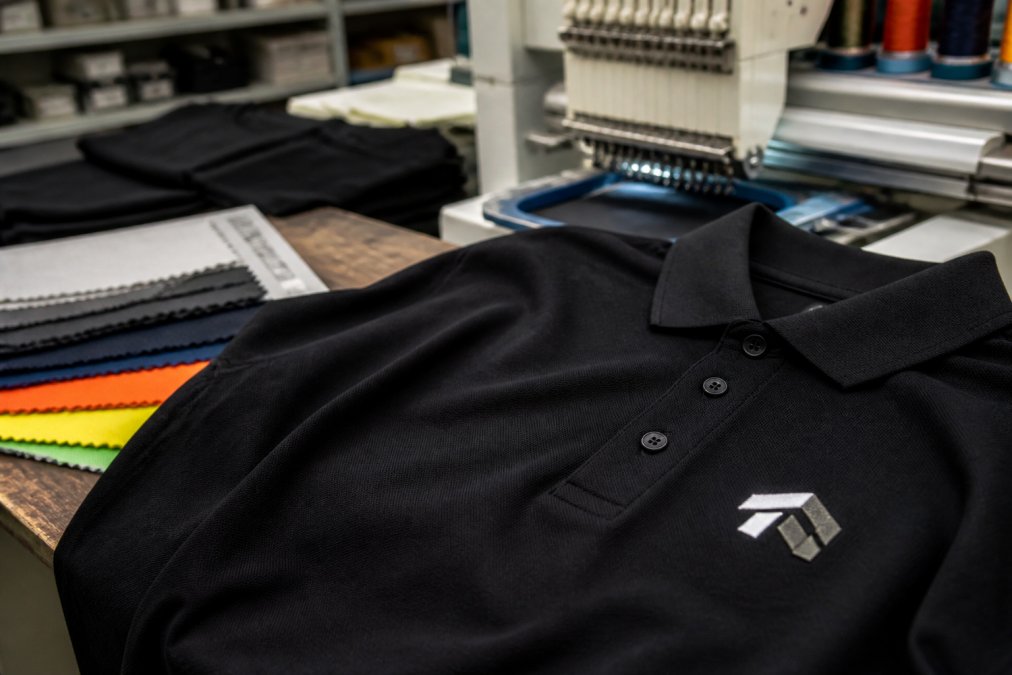
Embroidery suits logos, names, and small text, and it wears well on polos and fleeces. Screen printing suits larger graphics and bold block colour, and it can be faster on high volumes once a screen is set. For tight deadlines, embroidery usually wins on small chest logos because it needs no screen setup, while screen printing wins when you have one large design across many identical garments.
Benefits of Switching Custom Workwear Suppliers
The benefits of switching custom workwear suppliers come down to three things: consistency, control, and cost predictability. A supplier with in-house production controls the whole chain, which means fewer handoffs where mistakes creep in.
Bulk Ordering, Trade Prices and Cost Planning
Bulk ordering lowers the unit cost, but the real saving comes from planning. Trade prices reward volume, and a repeat ordering portal keeps your garment selection, sizes, and logo on file so reorders take minutes instead of a fresh conversation.
How Trade Pricing Usually Works
Ask for the tier boundaries in writing before you commit. A supplier that will not tell you where the next price break sits is usually protecting a margin rather than rewarding your volume.
What Should Be Included in a Trade Quote
A trade quote is only comparable if every line is named. Insist on seeing:
- Garment cost per unit, per size band
- Decoration cost per item
- One-off digitisation or screen setup fees
- Delivery, and whether split deliveries to multiple sites are charged separately
- VAT treatment, so you can compare like for like
Ask for an all-in quote that names digitisation, proofing, and delivery. A lower headline price with hidden setup fees is rarely the cheaper order.
Cost-Benefit: Branded vs Non-Branded Workwear
Procurement managers often ask whether branded uniforms are worth the premium over plain garments. The honest answer is that the case rests on three measurable factors:
Pro RTX Piqué Polo T-Shirt, 60°C Wash →
- Replacement rate. Branded garments are usually bought to a higher specification than generic site clothing, so they survive more wash cycles. Fewer replacements per year offsets a higher unit price.
- Staff retention and presentation. A consistent uniform reduces the need to reissue kit to new starters who arrive without suitable clothing, and it removes the cost of staff buying their own.
- Client perception. On client-facing sites, a unified appearance is often a contractual expectation rather than a nicety, which makes the uniform a cost of doing business rather than a discretionary spend.
Planning a Rollout Without Over-Ordering
Here is a simple way to budget a rollout:
- Count headcount by role, then add 10-15% for spares and new starters
- Separate core items (polos, trousers) from seasonal items (fleeces, jackets)
- Confirm the minimum order quantity for each garment
- Ask what is included: digitisation, proofing, delivery, and any setup fees
- Request a written quote before committing, so nothing appears at checkout
Hold the spare allowance as a buffer, not as stock. Ordering the buffer in the same size band as your largest department is a common mistake; spread it across the sizes you actually issue most.
Compliance, Durability and Care for Customized Workwear
Compliance and durability are where cheap workwear shows its limits. This is the area most suppliers gloss over, and it is the one that matters most if your team works on a regulated site.
Safety Standards and High-Visibility Garments
High-visibility clothing is not a generic category. Garments are tested against recognised European and international standards, and the specification you need depends on the risk assessment for the site. In practice, buyers should confirm:
- The garment's stated performance class and the standard it has been tested to
- Whether the standard covers the full garment or only the base fabric
- That any logo, transfer, or badge does not reduce the visible area of the reflective tape below the required minimum
Decoration Durability: Embroidery vs Print Over Time
Embroidery and print age differently, and the difference matters over a multi-year uniform programme.
- Embroidery is stitched through the fabric, so it does not peel or crack. Its main failure mode is thread colour fading after repeated high-temperature washing, and puckering if the digitisation was poor.
- Screen print sits on the surface of the fabric. It can crack, flake, or lift if the garment is washed at too high a temperature or tumble dried aggressively.
- Heat-applied transfers are the most vulnerable to heat and abrasion, and are usually the wrong choice for garments that will be industrially laundered.
Care and Maintenance Guidance
Extending the life of a garment is mostly about following the label and avoiding a few common mistakes:
- Wash at the temperature the garment is rated for, not higher. A polo rated for 60°C can be laundered to hygiene standards without the embroidery breaking down, which matters in healthcare and food settings.
- Turn embroidered items inside out before washing to reduce abrasion on the stitching.
- Avoid fabric softener on technical and moisture-wicking fabrics, as it coats the fibres and reduces performance.
- Do not tumble dry printed garments on high heat; air drying preserves the print.
- Repair or replace garments as soon as reflective tape becomes damaged, scuffed, or detached.
Sustainability as Part of the Brief
Sustainability is increasingly part of the brief. Choosing garments built to survive repeated industrial washing reduces how often you replace them, which cuts both cost and waste over a uniform programme's life. Where recycled or lower-impact fabrics are available in the lines you need, they are worth specifying, but the durability question comes first. A garment that is made from recycled material but fails after twenty washes is not the sustainable choice.
Frequently Asked Questions
What is the average turnaround time for embroidered workwear in the UK?
Most UK suppliers quote 7 to 10 working days for embroidered garments once artwork is approved. Express services can deliver in 3 to 5 working days, and some orders dispatch next day if stock is held and the logo is already digitised. EG Clothing keeps UK stock and runs in-house embroidery, which shortens the gap between order approval and dispatch. Always confirm the clock starts after you sign off the visual proof, not when you first enquire.
How can I ensure quality when ordering custom workwear with a short deadline?
Ask three questions before you commit. First, is the embroidery done in-house or outsourced? Second, can they send a digital visual proof before production? Third, what fabric weight and wash rating does the garment carry? A poly-cotton piqué polo tested to 60°C washing, like the Pro RTX range from EG Clothing, holds embroidery definition better than lightweight single-knit cotton. Request a pre-production sample for large orders and confirm the stitch count on the logo.
Does express workwear printing affect the durability of the logo?
Speed alone does not weaken a logo. Durability depends on the method and the fabric. Embroidery on a structured piqué weave typically outlasts heat transfer printing after repeated industrial washes. Screen printing works well on flat cotton but can crack if the garment stretches. If you need express turnaround and long-term durability, choose embroidery on poly-cotton garments rated for 60°C washing. Ask the supplier which method they recommend for your fabric.
What information do I need to provide for a quick workwear quote?
Send five things: garment type and quantity, logo files, placement position and size, required delivery date, and the sizes needed per person. If you do not have vector artwork, the supplier can digitise it, though this adds a small lead time. Mentioning that you need express delivery upfront lets them check stock and production capacity immediately. EG Clothing offers a pricing page, so you can see garment costs before you commit.
Switching uniform suppliers feels like a hassle until the first order arrives on time and every logo matches. EG Clothing handles digitisation, visual proofing, and in-house embroidery and printing under one roof, backed by trade pricing and a 4.8/5 customer rating from 3,915 customers. Start branding with EG Clothing and get your team kitted out without the wait.