

Quick Summary
Steel toe vs composite: steel toe boots give strong impact protection at a lower price, while composite toe boots are lighter, contain no metal and suit electrical work. Check the EN ISO 20345 rating on either boot before you buy.
- Steel toe caps are made from metal and are usually the lower-cost option.
- Composite toe caps are non-metallic, weigh less and are non-conductive.
- Composite toe boots are often more expensive than steel toe boots.
- Check the EN ISO 20345 reference and classification code on the boot.
- A poor fit can shift the toe cap out of position and reduce its protection.
Table of Contents
- Steel Toe vs Composite Toe: Key Differences at a Glance
- Impact and Compression Protection on Construction Sites
- Steel Toe vs Composite Toe Weight and Wearer Fatigue
- UK Safety Boot Standards and How to Verify Certification
- Electrical Hazards, Temperature and Durability Trade-Offs
- How to Choose Construction Safety Boots for Your Specific Job
- Booking Your Next Pair: Choosing Between the Options in Our Range
- Frequently Asked Questions
Steel Toe vs Composite Toe: Key Differences at a Glance
Steel toe boots offer the highest impact and compression resistance per millimetre of toe cap, but composite toe boots are lighter and contain no metal. For most UK construction work, the right choice depends on the hazards on your site. EG Clothing stocks both types, so you can compare them directly before you order.
Steel toe caps are made from metal. Composite toe caps are made from non-metallic materials. Composite caps weigh less than steel caps, and steel caps are more likely to set off metal detectors.
The table below summarises the main trade-offs. Read it as a starting point, not a verdict.
| Factor | Steel Toe | Composite Toe |
|---|---|---|
| Metal content | Yes | None |
| Weight | Heavier | Lighter |
| Metal detector alert | Likely | Unlikely |
| Electrical hazard protection | Conductive, so limited | Non-conductive |
| Typical cost | Lower | Higher |
| Best for | Heavy-impact, general site work | Electrical work, long shifts, metal-sensitive sites |
Steel toe pros: strong impact protection, usually lower price, widely available. Steel toe cons: heavier, conducts heat and cold, sets off metal detectors. Composite toe pros: lighter, non-metallic, suitable near electrical hazards. Composite toe cons: often costs more, and may be bulkier to achieve the same rating.
The underlying principle is simple. Steel gives you proven protection at a lower cost. Composite gives you a lighter, non-conductive option. Neither is automatically safer, so check the rating on the boot rather than assuming.
Impact and Compression Protection on Construction Sites
Impact and compression protection are the core reasons a safety toe exists. On a construction site, the danger is a heavy object dropped on the foot, or a foot trapped under a load (Construction general). The toe cap has to absorb that force without the boot failing.
The Warrior Chukka Boots from EG Clothing carry a steel toe cap rated at 200 Joules, with a steel midsole. When you look at any toe cap, compare the rating stated on the product marking or data sheet.
Composite toe caps can meet the same impact and compression requirements, but the ratings should be checked on each boot. The Result Work-Guard Stirling Safety Boots use a composite toe cap and composite midsole and meet EN ISO 20345:2011 S3 SRC. That standard is the one to look for when you compare protection levels.
Many people assume a steel toe always gives more protection. That is not reliably true. What matters is the certified rating and whether the boot fits well enough for the toe cap to sit correctly over the toes.
Watch out: a boot that is too long or too loose can shift the toe cap out of position, reducing its effectiveness. Choose a fit that keeps your toes clear of the cap without slipping.
Steel Toe vs Composite Toe Weight and Wearer Fatigue
Weight is the factor that most often decides which boot people keep wearing, but the difference between a steel and composite toe cap is smaller than many buyers expect. The toe cap itself typically accounts for only a fraction of the boot's total weight; the outsole, midsole, upper and any protective midsole plate usually contribute more. Weight differs between models, so compare the specification for each boot.
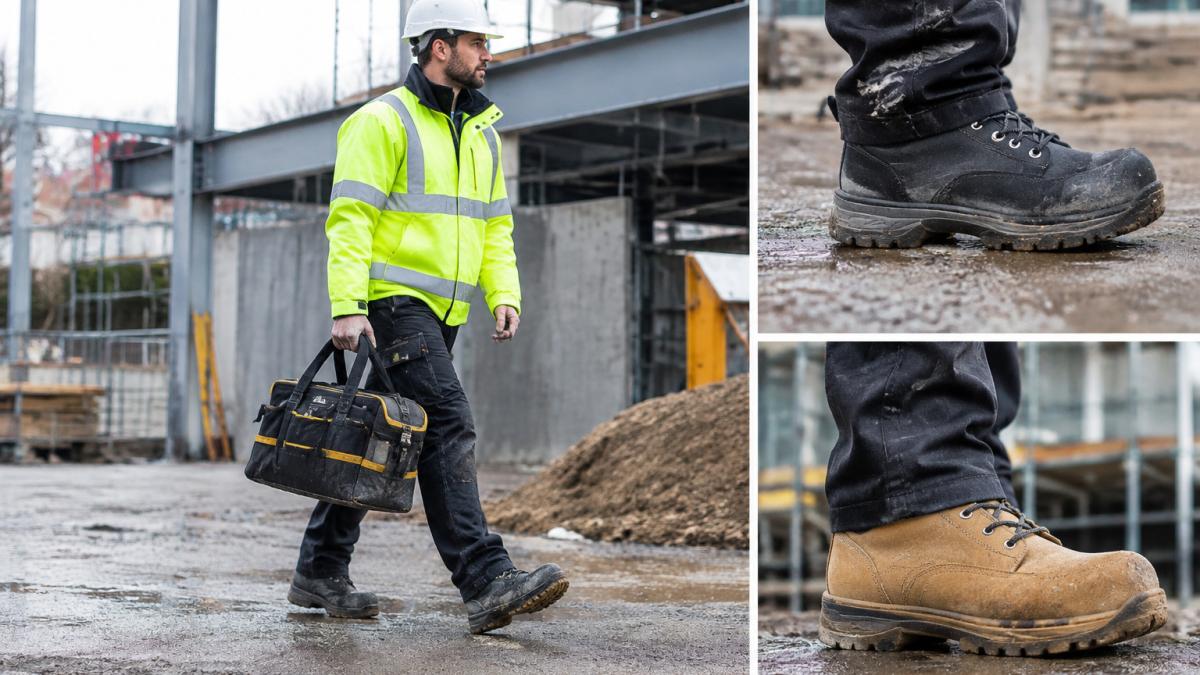
Where weight matters most is in the cumulative load over a shift.
Construction-task context changes the calculation:
- Groundworks and concrete work: boots spend long periods in wet, heavy conditions, and a more substantial boot with a stiffer outsole often feels more stable. The weight penalty is offset by reduced foot fatigue from a supportive platform.
- Framing and first fix: frequent movement between levels and across joists rewards a lighter boot with good ankle support. Composite toe models are often preferred here, but check that the outsole still offers adequate slip resistance.
- Demolition and material handling: heavy, unpredictable loads favour a boot with a robust toe cap and midsole. The wearer is less likely to notice weight than the protection on offer.
- Roofing and external work: ladder work and steep pitches make a lighter boot easier to control, but the outsole and heel design matter more than the toe cap material.
- Equipment operation: where feet are mostly on pedals or platform floors, fit and cushioning dominate; toe-cap weight is largely irrelevant.
Fit and break-in are just as important as weight. A boot that is too loose allows the foot to slide forward on descents, jamming the toes against the cap; a boot that is too tight restricts circulation and accelerates fatigue. Toe-box shape varies between models, some composite caps are bulkier to achieve the same rating, which can reduce toe room in a given size. Look for a boot that holds the heel securely, allows the toes to sit clear of the cap, and has enough cushioning underfoot for the surfaces you work on. Most quality safety boots need a short break-in period of a few days of light use.
Watch out: a lighter boot is not automatically less tiring if the fit is poor or the outsole is too soft for the ground conditions, weight is only one variable in the fatigue equation.
UK Safety Boot Standards and How to Verify Certification
Safety footwear is commonly assessed against EN ISO 20345 (bsigroup.com). Products are marked with a code showing the standard and the protection they provide, for example S3 SRC (Slip-resistant footwear).
In practice, the marking on the boot is the main thing to check. Look for the EN ISO 20345 reference and the classification code. Do not rely on a description that only says "safety boots" without quoting a standard. The Result Work-Guard Stirling Safety Boots are listed as meeting EN ISO 20345:2011 S3 SRC, and the Warrior Chukka Boots list a 200 Joule steel toe cap rating.
To verify certification, check the following before you buy:
- The standard reference, such as EN ISO 20345:2011
- The classification code, such as S3 or S5, and any extra letters
- The toe cap rating in Joules, where it is stated
- The manufacturer's product marking or data sheet
If a supplier cannot show you the standard or the rating, treat that as a warning sign. You can also ask your site safety officer which classification your site requires, since some sites set their own minimum.
Electrical Hazards, Temperature and Durability Trade-Offs
A boot with a composite toe cap is not automatically suitable for electrical work unless it carries the appropriate certification. Check the marking on the boot against the hazards on your site.
If your site requires protection against electrical hazards, confirm the requirements with your site safety officer and check that the boot is certified for that task.
Temperature performance follows a similar whole-boot logic. However, the upper material, lining and sock choice often have a larger effect on foot temperature than the toe cap. The Buckler Boots in the EG Clothing range are built for wet and muddy conditions and are neoprene-lined for warmth.
Durability depends on the whole boot, not just the toe cap.
Watch out: always check the full certification marking on the boot against the hazards your site presents.
How to Choose Construction Safety Boots for Your Specific Job
The right boot depends on the job. Start by listing the hazards you face, then match the boot to those hazards.
- Heavy materials and falling objects: a rated toe cap is essential. Either material can meet the requirement if the rating is adequate.
- Electrical work: choose a non-conductive composite toe.
- Wet and muddy sites: consider a waterproof design such as the Buckler Boots, which are rated for wet conditions and include a neoprene lining for warmth.
- Long walking shifts: a lighter composite boot, such as the Result Work-Guard Stirling Safety Boots, can reduce fatigue.
- Budget-conscious buyers: a steel toe boot, such as the Warrior Chukka Boots at £22.52, offers strong impact protection at a lower price point.
Pair the boot with appropriate workwear as well. Our durable workwear guide for construction crews covers the wider kit you need. Construction trousers are built to sit alongside safety footwear on site.
Common mistake: buying on price alone. The cheapest boot may not carry the rating your site requires, so check the marking before you compare prices.
Booking Your Next Pair: Choosing Between the Options in Our Range
Once you know which features matter for your work, the choice comes down to the boot itself. At EG Clothing, our range includes three options suited to different needs.
The Warrior Chukka Boots | Black are priced at £22.52. The Result Work-Guard Stirling Safety Boots | Black/Grey are priced at £41.17. The Buckler Boots are priced at £107.25.
Start by checking the standard, the rating and the fit against the hazards you face. Then compare the three options above.
Frequently Asked Questions
Are composite toe boots as safe as steel toe boots? Both can meet impact and compression standards when they carry the right certification. Check the marking on the boot, such as EN ISO 20345 with the relevant rating, rather than assuming either material is safer.
Which is lighter, steel or composite toe boots? Composite toe boots contain no metal. Weight varies between models, so compare the specification for each boot.
How do I know if a boot is certified? Look for the EN ISO 20345 reference and the classification code on the boot or its data sheet. If a supplier cannot show the standard, ask for proof before you buy.
Frequently Asked Questions
Are steel toe or composite toe boots better for construction?
Neither is better in every case. Steel toe boots offer strong impact and compression protection and tend to cost less, but they are heavier and conduct electricity. Composite toe boots are lighter, non-metallic and suit electrical work, but the best choice depends on the hazards on your site. Check your risk assessment and the EN ISO 20345 rating before deciding, and try both on for comfort over a full shift.
Do composite toe boots meet UK construction site safety requirements?
Yes, provided they carry the correct certification. Composite toe caps tested to EN ISO 20345 can meet the same impact and compression levels as steel, and the product label or specification should show the standard and rating. The Result Work-Guard Stirling Safety Boots, for example, are rated EN ISO 20345: 2011 S3 SRC and use a composite toe cap and midsole. Always confirm the rating matches your site requirements.
Which is lighter, steel toe or composite toe boots?
Composite toe boots are made from non-metallic materials. Weight varies between models, so compare the specification for each pair. Weight varies between models, so compare the specification for each pair rather than assuming composite always wins. Comfort and fit will matter more over a full shift than a few grams of difference.
Do steel toe boots set off metal detectors?
Yes, steel toe caps and steel midsoles can trigger metal detectors at airports, secure buildings and some sites with screening. Steel toe caps contain metal and may trigger metal detectors. Tell your site manager if you need a non-metallic option.
