

Table of Contents
- How These Workwear Suppliers Compare at a Glance
- Product Quality and Durability
- Embroidered Workwear Options and Logo Placement
- Printed Workwear and Branding Finishes
- Personalised Workwear Suppliers: Range and Customisation
- Workwear Delivery Times and Order Processing
- Pricing, Value, and Hidden Costs
- Which Supplier Fits Your Business Best
- Frequently Asked Questions
Last Updated: October 12, 2026
How These Workwear Suppliers Compare at a Glance
A workwear supplier comparison asks three things: quality you can trust, the customisation your brand needs, and budget fit.
The workwear supplier comparison comes down to trade-offs: MyWorkwear leans toward broad range and competitive pricing; Workwear Express around quick turnaround and embroidery expertise. Neither is universally "better".
At EG Clothing, we've seen hundreds of businesses focus on price first and regret it when delivery slips or embroidery disappoints. Start with durability, customisation and service reliability.
Here's what separates these two suppliers across the factors that actually matter:
| Factor | MyWorkwear | Workwear Express |
|---|---|---|
| Product Range | Extensive (shirts, trousers, jackets, hi-vis) | Focused (core workwear essentials) |
| Embroidery Quality | Standard | Specialised service |
| Typical Delivery | 5-7 working days | 3-5 working days |
| Customisation Options | Print and embroidery | Embroidery-focused |
| Best For | Large orders, variety needs | Speed, embroidery detail |
Product Quality and Durability
The difference between workwear that lasts one season and workwear that lasts three comes down to fabric weight, seam construction, and how branding survives washing.
MyWorkwear sources from established mills with decent fabric weight, and their polos and jackets use standard industrial stitching.
Workwear Express emphasises durability in their premium lines. Their heavyweight cotton blends and reinforced seams are noticeably better than budget alternatives.
Don't assume all workwear in the same price bracket performs the same: one supplier uses 200gsm fabric, another 160gsm; one reinforces stress points, another doesn't.
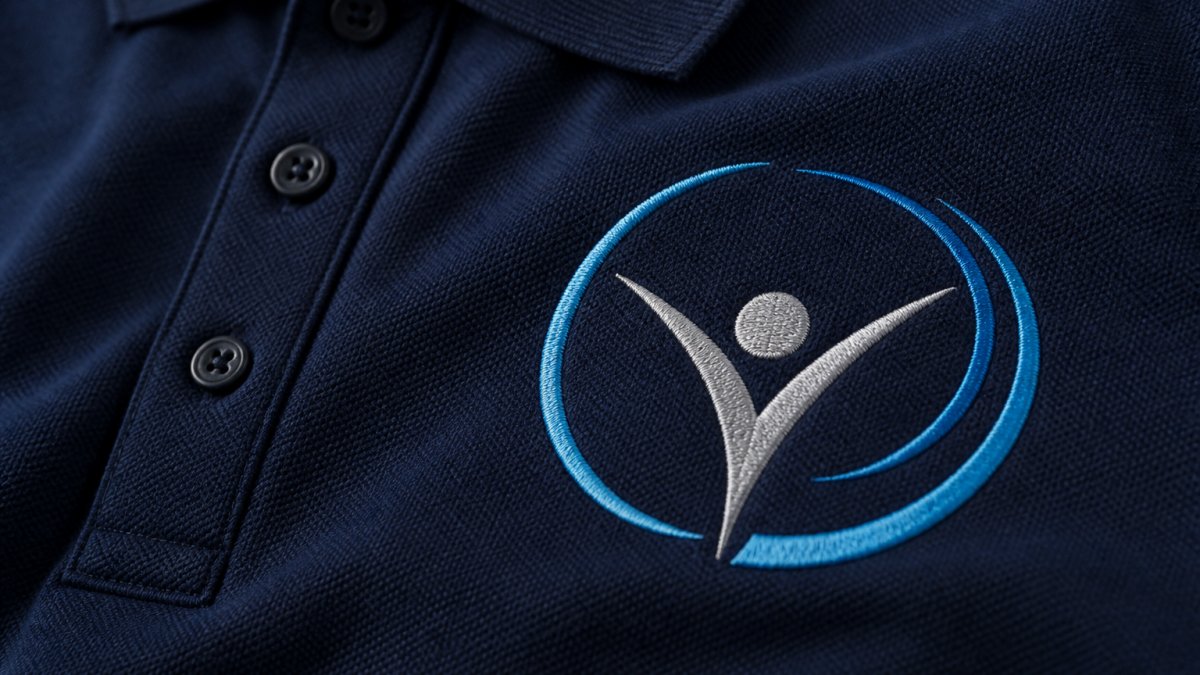
Durability isn't just the garment, a logo that cracks or fades after ten washes undermines brand consistency more than a worn sleeve.
For healthcare, hospitality or retail teams where appearance matters, inspect samples before committing to a large order and ask about fabric composition and seam type.
Embroidered Workwear Options and Logo Placement
Embroidery is where personalised workwear suppliers differentiate. Thread colour accuracy, stitch density and corner sharpness reflect directly on your brand.
Workwear Express has built its reputation on embroidery expertise: multiple thread colours, custom stitch densities, precise logo placement and clear quality control.
MyWorkwear offers embroidery as a standard service, but it isn't their specialisation.
Placement consistency is the critical difference: one business we worked with received fifty polo shirts with the logo two centimetres too high on half the batch. Both maintain placement standards better than many budget options.
For dental clinics, healthcare practices or professional services, embroidery quality matters. For construction or logistics, you're optimising for visibility and durability instead.
Printed Workwear and Branding Finishes
Printed workwear offers a different aesthetic: flatter, more detailed, better for photographic or multi-colour logos, and typically cheaper than embroidery at scale.
MyWorkwear offers screen printing as its primary method, durable and cost-effective for large runs, with colours that hold up reasonably well through washing.
Workwear Express also offers printing but emphasises embroidery in their marketing and service design.
The question most businesses don't ask until it's too late: what happens on a reorder six months later?
For branded workwear where consistency across orders matters, retail chains, corporate roll-outs, you'll spend more time managing files and colour matching with some suppliers than others.
Personalised Workwear Suppliers: Range and Customisation
When evaluating personalised workwear suppliers, range matters more than most businesses realise. You might need polos for front-of-house, fleece jackets for outdoor crews and hi-vis for safety compliance. Can one supplier deliver all three at consistent quality?
MyWorkwear has the broader range, polos, T-shirts, hoodies, work jackets, trousers, hi-vis and more.
Workwear Express focuses on core essentials. Their range is narrower but deeper, polos and jackets are excellent.
For small retail or hospitality businesses, one supplier relationship is easier to manage than two or three, making MyWorkwear the simpler operational choice.
The workwear supplier comparison here isn't about which range is "better" but which fits your needs. A construction firm needing only hi-vis and jackets doesn't benefit from MyWorkwear's broader catalogue; a dental practice needing polos, trousers and jackets benefits from consolidation.
Workwear Delivery Times and Order Processing
Advertised lead times tell you almost nothing. What matters is the full order journey, from artwork upload to delivery, and how each supplier behaves when something goes wrong.
The order journey, stage by stage
- Quote and specification. You confirm garment, quantity, branding positions, thread or ink colours, and deadline. This is where most delays are actually created, because an incomplete spec comes back as a question rather than a job.
- Artwork setup. Your logo is digitised for embroidery or separated for print. A clean vector file takes hours; a low-resolution JPEG can take a day or more to redraw, and redrawing is often chargeable.
- Proof approval. You receive a digital proof (and sometimes a physical sew-out for embroidery). Production does not start until you approve it in writing. Every day you sit on the proof is a day added to your delivery date.
- Production. Garments are picked from stock, branded, checked and packed. This is the stage where embroidery complexity and order size genuinely affect the timeline.
- Dispatch and tracking. Consignment leaves the warehouse with a carrier tracking reference.
- Delivery. Standard carriage is typically next-working-day after dispatch for mainland addresses; offshore and remote postcodes add time.
Where the two suppliers differ
Workwear Express builds its proposition around a compressed standard turnaround, and that quoted window generally includes the branding stage rather than blank stock only.
MyWorkwear's standard window is longer and flexes with embroidery complexity, a single-colour left-chest logo at the fast end, a multi-position or multi-colour design at the slow end.
The question that separates a good quote from a bad one
How each handles delays and urgent orders
- Rush options. Both offer expedited production for a surcharge, subject to capacity. Rush is a queue jump, not a guarantee, and still depends on you returning the proof promptly.
- Partial dispatch. If part of your order is ready and part is awaiting stock, ask whether they will part-ship at no extra carriage cost. This is often the fastest way to get new starters kitted out.
- Stock availability. Both hold stock domestically, avoiding the weeks an overseas manufacture-to-order model adds. But 'in stock' at quote stage isn't 'in stock' at production stage, confirm on the day you order.
- Delay notification. The real test of a supplier is whether they tell you about a delay before you chase them. Ask your account contact how delays are communicated and to whom.
What to record for every order
Keep the quote reference, approved proof, agreed lead time and dispatch tracking number together. On reorders, that record holds the supplier to the same specification and timeline, and it's the first thing you'll be asked for if a batch arrives wrong.
Confirm current lead times and carriage terms Confirm current lead times and carriage terms
Pricing, Value, and Hidden Costs
Most comparisons of these two suppliers stop at 'get a quote', not useful when budgeting a uniform rollout. Here is the cost architecture to expect, so you can compare like for like.
The five cost lines that make up a real order total
- Garment cost per unit, the blank item before any branding. This is the number both suppliers advertise, and it is the least useful on its own.
- Branding cost per unit, charged per logo, per position. A left-chest embroidery and a large back print are two separate charges, not one.
- Setup or digitising fee, a one-off charge to convert your artwork into a stitch file (embroidery) or a screen (print). This is usually waived on reorders once the file exists.
- Delivery, often free above a threshold, otherwise a flat carriage charge per consignment rather than per garment.
- Surcharges, rush turnaround, split deliveries to multiple sites, and small-order handling.
Where the two suppliers diverge in practice
MyWorkwear's pricing rewards breadth and volume. Because the catalogue spans polos, trousers, jackets and hi-vis, a mixed order tends to attract a better blended unit price than ordering piecemeal.
Workwear Express's pricing rewards speed and embroidery complexity. Standard turnaround is built into the quoted price rather than bolted on as a rush surcharge.
The hidden costs nobody quotes you
- Sample and pre-production garment costs. A branded sample before committing costs the garment plus branding. Some suppliers credit this back against the first bulk order; ask explicitly.
- Reprints caused by artwork errors. If the fault is yours (wrong file, wrong colour reference), you pay. If the fault is theirs (misplaced logo, wrong thread), they should. Get this in writing before you order, not after.
- Size exchanges on personalised stock. Branded garments generally cannot be resold, so exchanges are usually at the supplier's discretion. Order a size set first.
- Storage and phased delivery. If you want 200 garments produced but delivered 50 at a time, expect either a storage charge or a per-consignment carriage charge.
How to build a like-for-like comparison
Pick one representative garment, a mid-weight polo is the usual benchmark, and specify one left-chest embroidered logo at a fixed size, a stated quantity (say 25, 50 and 100 units), delivery to a single site, and standard turnaround.
For procurement officers running a formal tender, ask each supplier to break the quote into the five cost lines above. Itemised suppliers are easier to audit, reorder from, and hold to account when a line item changes on the second order.
Check current published trade and bulk pricing Check current published trade and bulk pricing
Which Supplier Fits Your Business Best
MyWorkwear suits businesses needing variety and consolidation. A restaurant chain wanting polos, kitchen coats and trousers from one supplier simplifies procurement; a multi-location retail operation gains from the range.
Workwear Express suits businesses prioritising speed and embroidery quality. A construction firm needing quick restocking of hi-vis and work jackets with crisp embroidered logos gets genuine strengths in their 3-5 day turnaround and embroidery expertise.
For dental practices and healthcare settings, weigh professional appearance (embroidery quality favours Workwear Express) against variety and consolidation (MyWorkwear's broader range). For small practices with 8-15 staff, a single supplier relationship reduces admin.
For warehouse and logistics companies needing safety-compliant hi-vis, both deliver. The decision comes down to speed (Workwear Express) versus cost efficiency across multiple product types (MyWorkwear).
The real question isn't which supplier is objectively better, but which solves your specific problem.
At EG Clothing, we work with businesses across all these sectors. The best supplier matches your workflow, not the lowest headline price or fastest delivery.
Choosing the right workwear supplier means balancing quality, customisation, and cost against your actual business needs.
Frequently Asked Questions
What is the main difference between MyWorkwear and Workwear Express?
Both suppliers offer branded workwear and customisation options, but they differ in product range, delivery speed, and service focus. MyWorkwear emphasises a wide selection of garments and printed options, while Workwear Express focuses on rapid turnaround and embroidery quality. Your choice depends on whether you prioritise speed, product variety, or specific branding techniques. Review each supplier's current offerings and lead times to match your business needs.
Which workwear supplier is better for small businesses?
For small teams, consider minimum order quantities, pricing structure, and customer support. Both suppliers work with small businesses, but some offer more flexible ordering or better per-unit value at lower volumes. Check whether either supplier offers trade pricing for small orders, and review their customer service responsiveness. A supplier with fast turnaround and no hidden fees may be more practical if your team size or branding needs change frequently.
Can MyWorkwear and Workwear Express embroider and print company logos?
Yes, both suppliers offer embroidered and printed workwear. However, capabilities vary by garment type and order volume. Ask each supplier about logo placement consistency across batches, stitch quality durability after multiple washes, and ink fade resistance. Request samples before committing to large orders to verify the finish meets your professional standards.
How do MyWorkwear and Workwear Express compare on delivery times?
Both offer standard and express options, but costs and timescales vary. Confirm current lead times directly with each supplier, as these change seasonally and with order volume. Factor in delivery time when planning uniform rollouts for your team.